National Curry Week!

November 22-28 is “National Curry Week” in the UK. Ah, how I wish I could be there! A Google Alert this morning took me to an interesting Liverpool Echo article (http://tinyurl.com/ydmobdo), which includes information on turmeric, chilli, garlic and ginger (and a curry recipe, too, on page 2). No need for me to comment on turmeric, right? And we are well aware that the capsaicin in chilli kills myeloma cells…and so does a ginger extract (see my Pages on the right).

But garlic? I haven’t written much about garlic (shame on me!). Apart from its well-known general health benefits (http://en.wikipedia.org/wiki/Allicin), I found several studies in PubMed on its keema-curry[1]anti-leukemia activity…hmmm, nothing specific about garlic and myeloma, but that simply means, methinks, that garlic extracts have not yet been tested against myeloma cells. If I were a researcher, I would request a grant to study this very topic, since I am almost 99.99999% positive that garlic would annihilate myeloma cells, too. Wanna bet?

Just out of curiosity, have a look at these two garlic-leukemia studies (I picked a couple at random, but there are many more on PubMed): (2004) http://tinyurl.com/ycxq7dh and (2009) http://tinyurl.com/yegomal. Incidentally, in the former, a garlic-derived compound called ajoene enhanced the killing effect of two chemo drugs used in the treatment of hematological malignancies: cytarabine and fludarabine. Now, that bit of news could easily set me off on my usual rant about how the only way we will be able to defeat cancer is via a combination of conventional and natural treatments…but I will refrain…today, at least! 

Now, back to National Curry Week for a moment. Ever since I found out about the healing properties of turmeric and other curry spices, I have been making delicious curry dishes, mainly in the winter. Curries are easy to make and relatively fast, once you are experienced enough to stop measuring exact quantities…now I simply glance at the recipe and throw in the spices, e.g. Another advantage of curries is that you can make them a day ahead…so they are perfect for dinner parties! In sum, I hope my UK readers will enjoy Curry Week! Yummy!

P.S. Here is what seems to be an interesting garlic-cancer (full) 2008 study: http://tinyurl.com/ye85asa (I haven’t read it yet, but I will!).

Chocolate eases emotional stress

On Sunday I played cards in a charity tournament, which meant being in a large room for several hours with at least 50 other card players and yes, some of them were coughing up a storm. I was very careful never to touch my face, of course, but I had to breathe! Then on Tuesday one of my students told me that she had had a high fever the previous night. She looked terrible and was still having chills alternating with sweats. I told her to go home immediately, but she said she had too much work to do. Sigh.

Well, this combination was probably a bit too much for my itsy bitsy immune system. Yesterday morning I woke up a headache, a bit of nausea, and, drum roll!…chills alternating with sweats. I slept for most of the day, surrounded by my devoted kitty nurses. I didn’t have a fever, so I think this must have been some sort of 24-hour minor bug…not H1N1 or even the regular flu. I feel fine this morning, in fact.

Okay, now for an infinitely more interesting topic. A recent Science Daily article reported on the results of a dark chocolate and stress clinical trial (see: http://tinyurl.com/y8jqd7a): The study provides strong evidence that a daily consumption of 40 grams [1.4 ounces] during a period of 2 weeks is sufficient to modify the metabolism of healthy human volunteers. This amount of chocolate reduced levels of stress hormones in the bodies of people feeling highly stressed. Well, this is more good news for those of us who enjoy a bit of chocolate especially since, as you may recall, the stress hormone norepinephrine makes our myeloma cells proliferate like crazy (for a reminder, see my page titled “Myeloma and stress”).

So have a piece of chocolate today, naaah, make that two!, and don’t forget to laugh. 

Life may not be the party we hoped for, but while we’re here we should dance.” (Unknown)

Experimental brain transplants

My sister sent this to me…and I just had to share…

Relatives gathered in the waiting room of a hospital, where a family member lay gravely ill.

The doctor finally came in, looking tired and somber. “I’m afraid I’m the bearer of bad news,” he said, surveying the worried faces. “The only hope left for your loved one at this time is a brain transplant. It’s an experimental procedure…very risky, but it is the only hope. Insurance will cover the procedure, but you will have to pay for the brain yourselves.”

The family members sat in silence, absorbing the news.OrganFlyIntoAir[1] After a few minutes, someone asked, “Well, how much does a brain cost?”

The doctor quickly responded, “$5,000 for a male brain, and $200 for a female brain.”

The moment turned awkward. Avoiding eye contact with the women, the men in the room tried not to smile, but a few couldn’t help but smirk. Finally, one of the guys blurted out the question everyone wanted to ask, “Why is the male brain so much more?”

The doctor smiled at their childish innocence and explained, “It’s just standard pricing procedure. We have to mark down the price of the female brains, because they’ve actually been used.”

Curcumin and the H1N1 flu virus: the full study

This is a continuation of my November 7 2009 post on *the first report demonstrating that curcumin exerts anti-influenza activity*. Before jumping into the full study, let’s have a quick look at a couple of items mentioned in the abstract (see: http://tinyurl.com/ybug9sl). The first is one that I had never seen (or paid attention to) before: haema-something-or-other, uhm…let’s see…ah yes, haemagglutination, or hemagglutination with the U.S. spelling. The linguist in me tried to figure out the etymology of this term, but that led me nowhere: the gluing of blood? Blood glue? I finally had to look it up. It means: the clumping of red blood cells (voilà!) caused by viruses, antibodies or other substances. And, according to this study, curcumin inhibits the hemawhatever process. My first question was: is that a good thing? Let me see…yes indeedie, it is. See, e.g.: http://tinyurl.com/q2zys9 and http://tinyurl.com/yfdab7j

The second item is amantadine, which is an antiviral drug administered in cases of oseltamivir-resistant H1N1 flu (oseltamivir is better known as Tamiflu). Amantadine was used in this study as a control for the drug resistance test. Two important findings: 1. in contrast to amantadine, viruses did not develop resistance to curcumin; 2. like amantadine, curcumin inhibited influenza virus plaque formation. Okay, now for the full study.

After giving us the usual overview of curcumin’s multifaceted effects, the authors tell us that Recently, several reports demonstrated that NF-kB inhibitors efficiently blocked propagation of influenza, suggesting that modulation of NF-kB signalling may be a target for anti-influenza intervention. Aha! Inhibition of our old archenemy, NF-kappaB…well, that happens to be right up curcumin’s alley. In fact, that is why curcumin was tested in this study in the first place. And, come to think of it, wouldn’t it follow that any old NF-kappa B inhibitor would block the H1N1 virus? If so, then we would be able to choose from a wide array of natural extracts…not just curcumin but also resveratrol and green tea, just to mention a couple…

At any rate, the researchers administered various doses of curcumin (dissolved in DMSO) at three different times: 1. before infection, 2. together with the virus, and 3. after the virus had been added to the cells. They found that the production of virus was significantly reduced upon treatment with curcumin in a dose-dependent manner; in the presence of 30 micromoles of curcumin, the titre of virus was less than 5% of that in mock-treated cells at all time points of infection analysed.

Based on their tests (I will spare you all the details!), the authors postulate that curcumin may directly interfere with a very early stage (possibly directly with the virus particle), to prevent infection. Curcumin was also found to be effective against avian flu (=H6N1).

Let’s go back to the abstract for a second. It ends with a rather puzzling sentence: the methoxyl groups of curcumin do not play a significant role in the haemagglutinin interaction. The full study sheds some light on this issue (skip this paragraph unless you are fascinated by methoxyl groups…): Commercially available curcumin consists of three major components: curcumin, demethoxycurcumin, and bisdemethoxycurcumin. The structure of curcuminoids differs only by the number of methoxyl groups. So one of the study aims was to determine what part these methoxyl groups played in the Flu Virus Battle. Apparently none whatsoever, since all three curcuminoids were effective against the virus, regardless of methoxyl group content. (Yep, I am yawning, too!)

An issue of huge importance is viral resistance. Flu variants resistant to oseltamivir/zanamivir as well as to amantadine and rimantadine have already popped up all over the world. The researchers compared amantadine and curcumin and found that resistant strains developed to amantadine but not to curcumin, indicating treatment of curcumin is not prone to emerging of resistant viruses. Good to know.

Many blog readers have asked me about dosage. Ah, this is where things get a bit muddled (for me, at any rate). Since the abstract is available online, let’s look at this excerpt: treatment with 30 micromoles of curcumin reduced the yield of virus by 180px-Close-up_of_mole[1]over 90% in cell culture. Okay, let’s take a deep breath…micromoles. No, these are not teeny tiny moles (right photo) digging teeny tiny holes in our gardens and no, they are not even itsy bitsy marilyn monroe[1]beauty marks (left photo). Okay then, if you really must know, in scientific measurements, a micromole is a concentration of one one-millionth of a mole per liter. Ah yes, this is soooo helpful (not!!!).

Well, I have never hidden the fact that math has never been my forte. I looked at conversion charts and molecular weights and filled page after page with divisions and multiplications until I became quite giddy. I gave up.

My blog reader Rebecca has already tried to answer the question for me: her naturopath told her that it would be impossible for us to reach the concentrations used in this cell study. Well, that is certainly, uhm, encouraging…

But hey, all is not lost, in my opinion. As I have mentioned in previous posts (and this is confirmed by private exchanges I have had with Prof. Aggarwal), curcumin works at different levels inside the body. Not just in the bloodstream. And in fact, ever since I began taking curcumin I have been much healthier, as strange as that may sound. It could be a mere question of mind over matter, but I doubt it. Something is definitely happening…

In conclusion, I figure that curcumin, in association with a healthy diet, exercise and a huge dose of caution–avoiding crowded places, washing our hands frequently, etc.–will lend a hand, if only a micromole-sized hand!, in protecting us during this flu-ridden period (I just heard that 1.5 million Italians have contracted the influenza A, or H1N1…yikes!). I have to believe that…otherwise, reading, doing research for, writing and posting about this study has been a complete waste of my/our time…sigh!

A case of spontaneous remission in smoldering myeloma

A blog reader (thank you!) sent me a remarkable study published in the “Journal of Clinical Oncology” (JCO) in October 2009. Unfortunately, there is no abstract (you won’t need it, though, since I will give you a summary of the study…uhm, just don’t tell anyone…shhh!). The title says it all: “Spontaneous Remission in a Patient With t(4;14) Translocation Multiple Myeloma.” Spontaneous REMISSION? Wow.

I had to look up the meaning of “t(4;14) translocation.” A 2007 study (see: http://tinyurl.com/ylqjves) informed me that patients with this translocation apparently have “reduced survival” and their myeloma is characterized by drug resistance and rapid relapse. It does not respond well to conventional chemotherapy. (More details are available in the full study, available for free online at the link provided.)

Okay, now back to the JCO study. In December 2005, a 60-year-old woman with high ESR (121 mm/h!) and low Hb (113 g/L) was diagnosed with asymptomatic, or smoldering, myeloma. More precisely: Durie-Salmon stage 1A/International Staging System stage I multiple myeloma.

At that time, her IgA (kappa) was 30,3 g/L, her bone marrow had 20-30% of the evil cells, and skeletal x-rays revealed osteopenia (that means lower than normal bone density) and “multiple subtle lucencies.” Her creatinine was slightly elevated, but the rest of her markers, unless I missed something, fell into the normal range. I noticed that her B2M was right on the high end of normal, though. And then, of course, there was this business of the above-mentioned t(4,14) translocation.

I was puzzled by her SMM diagnosis, actually, given the t(4,14) translocation and the “subtle lucencies.” That doesn’t sound like asymptomatic myeloma to me, but of course I am not an MD. Well, let’s go on.

There follows a series of technical terms that I do not fully comprehend…just to give you an example: tests revealed the presence of a hyperdiploid karyotype with trisomies of chromosomes 3, 4, 9, 18, and 19, and monosomy 13, as well as a focal deletion on chromosome X containing […] three genes that have been implicated in the pathogenesis of cancer. I don’t have the time to look up this stuff right now, so I will simply have to ignore it.

She was treated only with monthly intravenous infusions of pamidronate. Incredibly, her M-protein began declining. In December 2005, her IgA was 30,3 g/L; in June 2006 it had decreased to 2,23 (!). At that time no paraprotein could be detected by immunofixation. A BMB revealed the presence of a mere 5% neoplastic cells, and her blood tests, freelite included, were all normal. Her skeletal survey remains unchanged.

More details (doing a bit of copy and paste here, to make things clearer). The authors inform us that their patient was also diagnosed with type I cryoglobulinemia IgA-kappa. Cryoglobulinemia refers to the presence of immunoglobulins in serum that precipitate at cold temperatures. In fact, one of my dearest blog readers has this type of problem. In winter he has to stay mostly indoors.

Her type I cryoglobulinemia IgA-kappa was diagnosed in 1985 when she presented with arthritis, purpura, and Raynaud’s phenomenon. Cryocrit had ranged from 0%to 25% over the years and most recently was 5%. She did not require treatment until 1989, when she was placed on low-dose prednisone 5 to 7.5 mg/d.

After almost four years, the woman is still in complete remission. The authors say that they have documented spontaneous remission (SR) in a patient with IgA-kappa MM only receiving pamidronate and intermittent low-dose prednisone. SR of cancer is defined as a complete or partial, temporary or permanent disappearance of all or at least some parameters of a soundly diagnosed malignant disease without any medical treatment or with treatment that is considered inadequate to produce the resulting regression. This is an extremely rare event with a reported incidence of less than one in 60,000 to 100,000 people with cancer.

To the authors’ knowledge, there is only one other documented case of SR in myeloma, a 68-year-old man with multiple lytic lesions and nonsecretory myeloma. His case, briefly: after having surgery on his spine, he developed a a Staphylococcus aureus infection. After 10 cycles of chemotherapy with vincristine, cyclophosphamide, melphalan, and prednisone/vincristine, carmustine, doxorubicin, and prednisone, García-Rayo et al documented complete radiological resolution of the bone lesions precipitating the diagnosis and absence of plasma cells in a repeat bone marrow biopsy. This was interpreted as a case of SR in the context of infection. Infection…interesting, huh?

The researchers point out that nitrogen-containing bisphosphonates can have antitumor effect in human myeloma cells in vitro. But the results from murine models have been contradictory. Based on the literature, there seem to be only four cases suggesting antimyeloma effects of bisphosphonates, specifically pamidronate.

The study concludes: Recently, it has been discovered that nitrogen-containing bisphosphonates such as pamidronate can stimulate human gamma delta T-cells, both in vivo and in vitro. We speculate that the cytolytic activity against MM cells exerted by gamma delta T-cells stimulated by pamidronate could be one of the mechanisms responsible for the SR of our patient, as we were not able to demonstrate direct antitumor activity of pamidronate against cells lines or primary patient samples in vitro (results not shown).

What to conclude from this? The authors don’t know for sure, and I certainly am not going to start having pamidronate infusions (=side effects can be really nasty). But I would be curious to know if any readers have derived benefits from pamidronate. Please drop me a line or, better yet, leave a comment here if you have. Thanks!
Okay, listen up, MGUSers and SMMers!

This morning a blog reader (super duper thanks!!!) sent me the link to a paper that will be presented at the upcoming ASH (=American Society of Hematology) annual meeting. See: http://tinyurl.com/ykye8pf

Well, this was a bit of a shocker (in a very good sense!) that made me drop everything I was doing and write this post…

In a nutshell, a Japanese MGUS patient (IgA-kappa) began taking something called hesperetin-7-glucoside, a more bioavailable form of hesperetin, which is a flavanone found in grapefruit and oranges (citrus fruit in general). And the patient’s M-protein decreased from 2,080 to 878 mg/dL over a three-year period. Her/his hematologists took notice, good for them!, and decided to test this compound on MM cells.

They found that Hesperetin showed inhibitory effects in a dose-dependent manner on the growth of 4 myeloma cell lines and freshly isolated myeloma cells. And hesperetin also turns out to be a proteasome inhibitor, just like curcumin and bortezomib (=Velcade). In the experiments, hesperetin annihilated the myeloma cells. Based on these results, an open-label, pilot clinical trial to test the efficacy of hespertin recently began for asymptomatic myeloma patients. Well, please go have a look at the abstract, which isn’t too difficult to read.

Now, this topic definitely deserves more attention, but today I have a bunch of errands to run, so I must put it on hold…like everything else, for that matter!

Oh heck, just quickly…let’s see (I can’t help it, the errands will simply have to wait a sec)…here is an interesting Finnish 2001 study showing the high plasma concentrations of hesperetin (and naringenin): http://tinyurl.com/ybhajrv Brilliant! Well, I will have to make and drink more citrus-based juices from now on, that is for sure.

Speaking of grapefruit, a few words of warning for those doing chemotherapy: avoid drinking grapefruit juice or eating grapefruit without asking your doctor first. Grapefruit contains compounds that block an important enzyme found in the gut and liver. Simply put, this inhibition causes an increase in blood levels of chemo drugs (or of any other substance, for that matter). That is, when chemo patients drink grapefruit juice, drugs that are usually eliminated quickly via that particular enzyme are able to remain in the bloodstream for longer than warranted. Obviously not a good thing. The reverse is true in the case of poorly bioavailable substances, such as curcumin. Drinking grapefruit juice with curcumin probably helps us absorb it better. 

At any rate, those of us who aren’t on chemo AND aren’t allergic to citrus fruit have absolutely nothing to fear. So, go ahead and drink up! Yum yum.

P.S. For more information on flavanones: http://tinyurl.com/ybsge86 (Here you will also find a helpful chart that distinguishes between flavone, flavonol, flavanone and flavanonol.)

Health fears are nothing to sneeze at

Quite a few people have asked me if the full curcumin-H1N1 study mentions which curcumin dose works against H1N1. No, unfortunately, it doesn’t. This is an in vitro study…infected cell cultures and test tubes and big-name assays and the usual technical thises and thats. The authors do say, however, that the doses they used were below the cytotoxic (=toxic to cells) level. I will see if I can find something more helpful in the study later on today.

By now, everywhere we go, we are bound to run into coughing and sneezing people. In fact, whenever I think about it, I find it extraordinary that, in spite of my almost nonexistent immune system (=as I wrote the other day, my hematologist was astounded that I wasn’t ill all the time), I am as healthy as a horse, whereas my students are falling one by one, like leaves in autumn. I won’t hide that I am apprehensive, but so far I haven’t had even the slightest of sniffles. Is it my daily intake of curcumin? Is it the Broncho Munal that I began taking in September (I am at the end of the third and final cycle now)? Is it my increased intake of vitamin D3? Or is the H1N1 virus being scared away by the mere presence, in my house, of a bottle of Sambucol (=black elderberry extract)? I have no idea. Whatever it is, though, it is working…and I hope it continues to do so (knock on wood, tocca ferro)!

Since I am still reading, writing and doing research (ah, don’t even ask about the curcumin-esophageal study…mamma mia, that one had me spinning in so many different directions that I had to shove it into a drawer for the time being, just to catch my breath!), I thought I would give you the link to a HealthDay article on a fascinating, recently-published, er, sneezing study: http://tinyurl.com/ydn7tkn

It’s amazing to think how much we are influenced by, and fearful of, a sneeze or a cough…from now on, perhaps we should try to remember what one of the study authors says (see above link): “about one out of 80 people have gotten H1N1,” which means that “there’s a 79 out of 80 chance the person you heard sneeze doesn’t have it.”

To this, let me add that Dr. Ugazio, President of the Italian Pediatric Association’s Vaccine Committee, said yesterday in an interview that H1N1 is a “media-hyped virus,” and that the regular flu kills ten times as many people (hmmm, not a comforting thought, actually). He is absolutely right…you wouldn’t believe the H1N1 media frenzy going on right now here in Italy…

Still, I can’t help it…the mere thought of someone sneezing or coughing in my vicinity makes me run for my bottle of curcumin…

Curcumin inhibits the H1N1 flu virus, too???

Okay, okay, I know that curcumin does this that everything and more besides, but I would never have thought that it ALSO inhibits H1N1!!! But it does. Incredibly. A blog reader (merci!!!) sent me a recently published study on this very topic, see abstract: http://tinyurl.com/ybug9sl After reading the abstract, I commented to Piccolo (my male kitty), “non ci posso credere, non è possibile!!!” (= I can’t believe it, this isn’t possible.) He batted his handsome yellow eyes at me, as if to say, “silly girl, why didn’t you just ask me? I knew it!”

Well, I don’t have enough time right now to provide a full report, although I am itching to do so!…but my mother-in-law is coming over for lunch in less than a half hour, and I have a few things to do before she gets here (such as making our bed!, even though the cats, as usual, are draped all over it and will not cooperate at all…).

The study shows that curcumin greatly reduced the impact of influenza A at non-toxic doses. The authors write: To our knowledge, this is the first report demonstrating that curcumin exerts anti-influenza activity, and the anti-influenza effect is via a mechanism that abolishes virus-cell attachment. To my knowledge, too! Oh, I am sooo grateful to my blog reader for sending me this full study. A big round of applause!

For lack of time, I am going to cut and paste the Conclusions part, highlighting the main points. The researchers tell us that 1. curcumin interrupts virus-cell attachment, which leads to inhibition of influenza virus propagation; 2. curcumin has an established safety profile and high SI value of 92.5, and 3. hence, curcumin has promising potential for use as an anti-influenza drug. Yesssss!

[I had no idea what “SI value” meant, so I had to look it up and finally found that it means “selectivity index,” implying, methinks, that curcumin is able to select its “target” (the evil cells, probably…?), without interacting with “other targets” (the healthy cells?). If I understood SI correctly, curcumin turns out to possess a very good therapeutic index, which is good to know.]

I will read the study more carefully tomorrow and probably add a few more titbits from the full study. Sorry to be in such a terrific hurry, but I thought I should get this bit of news published on the blog as soon as possible…

Oh, one final remark. My bottles of Sambucol arrived from the UK yesterday. Super. Now, with my usual curcumin dose and my increased daily intake of vitamin D, I should be all set. Oh, and let me also mention that Stefano and I are having our regular yearly flu shot on Tuesday. Not the H1N1 vaccine, mind you…my haematologist strongly recommended against it (in my case). Oh drat, my mother-in-law just got here…bed still unmade…uffa! 😉

Nature abhors a vacuum

A friend sent me the funniest thing last night. I don’t care if this is a hoax, it made me laugh. Enjoy! 

The following questions were set in last year’s GCSE examination in Swindon, Wiltshire (U.K.). These are genuine answers (from 16 year olds):

Q. Name the four seasons. A. Salt, pepper, mustard and vinegar.

Q. Explain one of the processes by which water can be made safe to drink. A. Flirtation makes water safe to drink because it removes large pollutants like grit, sand, dead sheep and canoeists. [Margaret: I want to know where this kid lives, so I will never go there…sounds like a scary place!]

Q. How is dew formed? A. The sun shines down on the leaves and makes them perspire. [Margaret: a poet in the making…]

Q. What causes the tides in the oceans? A. The tides are a fight between the earth and the moon. All water tends to flow towards the moon, because there is no water on the moon, and nature abhors a vacuum. I forget where the sun joins the fight. [Margaret: I hear ya. I’m quite lost, too, at this point…]

Q. What guarantees may a mortgage company insist on? A. If you are buying a house they will insist that you are well endowed.

Q. In a democratic society, how important are elections? A. Very important. Sex can only happen when a male gets an election.

 Q. What are steroids? A. Things for keeping carpets still on the stairs.

Q. What happens to your body as you age? A. When you get old, so do your bowels and you get intercontinental. [Margaret: I can’t wait!]

Q. Name a major disease associated with cigarettes. A. Premature death.

Q. How can you delay milk turning sour? A. Keep it in the cow. [Margaret: brilliant…I hope this kid got some extra points.]

Q. How are the main 20 parts of the body categorised (e.g., the abdomen)? A. The body is consisted into 3 parts – the brainium, the borax and the abdominal cavity. The brainium contains the brain, the borax contains the heart and lungs and the abdominal cavity contains the five bowels: A, E, I, O and U. [Margaret: ok, I’d like to know what happened to the other 17 parts…]

Q. What is the fibula? A. A small lie. [Margaret: teehee 1.]

Q. What does ‘varicose’ mean? A. Nearby. [Margaret: teehee 2.]

Q. What is the most common form of birth control? A. Most people prevent contraception by wearing a condominium.

Q. Give the meaning of the term ‘Caesarean section’? A. The caesarean section is a district in Rome. [Margaret: next time I go to Rome, I must check that out.]

Q. What is a seizure? A. A Roman Emperor. (Julius Seizure, I came, I saw, I had a fit). [Margaret: so did I, by the time I’d finished reading this list…]

Q. What is a terminal illness? A. When you are sick at the airport. [Margaret: extra points for this answer!]

Q. Use the word ‘judicious’ in a sentence to show you understand its meaning. A. Hands that are judicious can be soft as your face.

Q. What does the word ‘benign’ mean? A. Benign is what you will be after you be eight.

What the…???

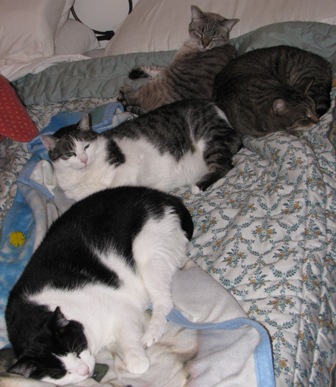
At the end of June my gynaecologist told me that I should have a mammogram. I couldn’t and can’t remember the last time I had one (=another one of those “fun fun fun…NOT!” tests…). It could have been when I was in grad school, or, more likely, when Stefano and I were considIMG_3630ering enlarging our family, which didn’t happen the way we had hoped (for reasons that should be rather obvious)…but, in the end, did happen. We now share our lives with 4 small furry loving funny bundles of joy. This morning the happy bundles were all snuggled together on my side of our unmade (sorry about that!) bed, as you can see.

At any rate, I tried to make an appointment for a mammogram in July but was told to call back in the fall. I have been busy, though, and, well, just haven’t gotten around to it.

Then this morning I happened to read an October 20th New York Times article…an interview with Dr. Otis Brawley, chief medical officer of the American Cancer Society, which I think everyone should read. No need for an introduction: http://tinyurl.com/yaaqka7.

Oh boy…well…uhm…well, uhm, as we say in Italian, non ho parole. I am at a loss for words.