Florence and Volterra in two days

We have had a faaabulous weekend. It involved a huge amount of walking, which was tiring but well worth the effort. On Saturday, Stefano and I went into town to stretch our legs (this turned into a five-hour nonstop trek…ooofff, I thought my legs were going to fall off toward the end!), take some photos and check out the festive street decorations/lights as well as the cute Xmas market in piazza Santa Croce. [Note: on your first visit to Florence, make sure that the square and church of Santa Croce are on your not-to-be-missed list.]

Our trek began in Piazza Beccaria and continued through Piazza Sant’Ambrogio, Piazza Santa Croce, Piazza della Signoria, Piazza Duomo and finally through the market of San LorenIMG_3716zo where we hoped to grab a bite in one of our favourite eateries is (but by the time we arrived, there was at least an hour’s wait so we just ended up having a revolting slice of pizza elsewhere, yuck!). Then back to Piazza Beccaria where we had parked our car.
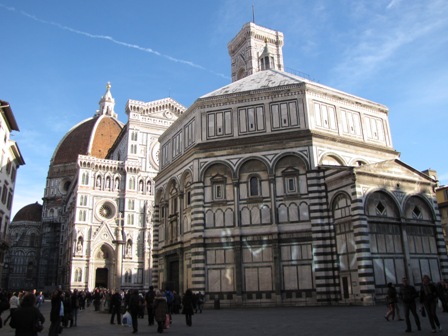
But it was when we reached Piazza Duomo, = Florence’s cathedral square, that my eyes almost popped out of my head. In late October, you see, Piazza Duomo became a traffic-free zone…but Stefano and I hadn’t yet been into town, so what we saw was new to us.

I used to hate to go into town, truth be told. Too much traffic, too much foul polluted air, too much noise from honking cars and so on. But now, without cars, scooters, taxis or buses…only people strolling about or riding their bikes right smack in the middle of the formerly traffic-congested streets…the square actually seems much larger. It was fantastic…hats off to the municipality of Florence for making such a brilliant decision. I took the above photo (baptistery in the foreground) standing in the middle of via de’Cerretani, which used to be a nightmarish street…from a pedestrian’s point of view, of course. Taking a photo from this angle would have been impossible just a couple of months ago…IMG_3786
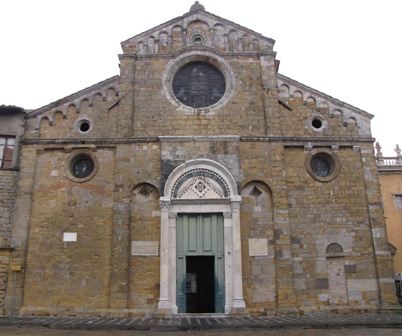
Yesterday morning we woke up and decided to go to Volterra, a gorgeous ancient Tuscan city to the southwest of Florence, which was settled by the Etruscans in the 8th century BC and conquered by Rome about five centuries later, as I recall. I haven’t been to Volterra since I was a kid with an enormous interest in all things Etruscan, an interest that I still have.

This (above) is a photo I took of Volterra’s cathedral, built in the early 12th century. The façade is Romanesque, as you can see…the marble geometric frame around the main entrance was added in the 13th century.
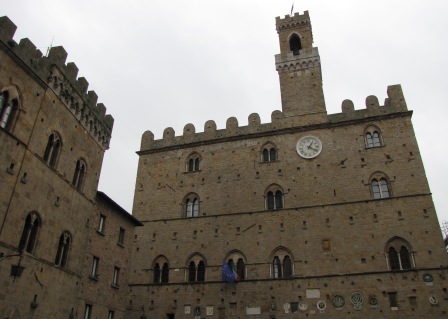
IMG_3805This photo (left) gives you an intentionally distorted (by me) view of a couple of the buildings in Piazza dei Priori. The one on the right is the early 13th century Palazzo dei Priori studded with Della Robbia glazed terracotta coats of arms dating to the 15th and 16th centuries (I hope to make a blog banner out of them at some point, which should give you a better view of them). It looks familiar, doesn’t it? Well, in fact, I read that it was the inspiration for Florence’s own Palazzo Vecchio, built at the end of the 13th century. Curiosity: I read that some scenes from “New Moon” were filmed inside this ancient building. Not that I am a huge fan of the “Twilight” series…

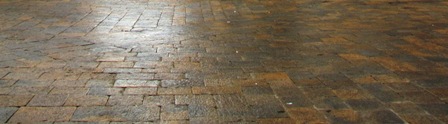
When you are in Volterra, don’t forget to look down at the stone pavement. Yesterday the massive stones, IMG_3785some of which contain fossil shells, were slightly wet, thanks to a bit of light rain…ah, what amazing colours. At the time, I wasn’t thinking about posting a photo of the city’s pavement on the blog so this, unfortunately, is the best I can offer.
Okay, my time is up. I am on a brief break (so please forgive any typos or repetitions) from a day spent on overdue housecleaning activities. Ah, joy! (not…!) Ciao!

P.S. by the way, I forgot to mention that my current blog banner is a photo I took of a wall fresco fragment in Herculaneum more than two years ago.  

Interview with Prof. Bharat Aggarwal: thinking outside the box

It is raining in Florence today, it’s damp, chilly and miserable out there, but for me it couldn’t be a lovelier, sunnier day. Ah yes, thanks to a December 2009 interview with Prof. Bharat Aggarwal that I read this morning, I am as happy as a purring cat. A blog reader sent me the link, thank you sooo much. The interview contains a huge amount of valuable information…in just two pages. The main thing, in my opinion, is that it answers many of our questions and doubts about the bioavailability of curcumin. But there is much more, too, so please have a look: http://tinyurl.com/yzbeptx

The issue of bioavailability is of particular relevance to those of us who take curcumin. Yes, Prof. Aggarwal is right, curcumin is cheap compared to conventional drugs. But it can still be a drain on our household finances (I am lucky to have very generous, loving parents!). Think of it this way: you wouldn’t buy a pair of jeans that was three sizes too big/too small for you, right? No, you buy a pair that fits. The same principle applies to curcumin or anything else, for that matter. You want to invest in something that fits/works/etc. That is why I always tell people who want to start taking curcumin to try it for a couple of months and see if their cancer markers go down. Ah, but I digress, as usual.

My point is, and I have written about this in previous posts, if curcumin does not show up in huge amounts in the bloodstream, it is probably working at some other level. Otherwise, how could I have remained stable for almost four years? How could it work for so many of my blog readers/myeloma list friends? That would make no sense. Well, we don’t have to wonder anymore. Prof. Aggarwal explains very clearly what happens when we swallow our daily dose of curcumin. I think that this interview provides us all with plenty of food for thought.

He points out that curcumin is circulated quickly and is taken up by tissues very quickly. Within 10 to 20 minutes it is already in the brain. Consequently, it is pointless for researchers to attempt to find traces of curcumin in the bloodstream. Aha.

I was particularly interested in his answer to the last question…I didn’t know that 30% of all cancers are indolent. Wow, that is quite a high percentage! And I loved the way he compared asymptomatic cancer to a tiger: With cancer, in some cases the tiger is sitting there somewhere and needs to be left alone. If you start throwing stones at the tiger, he will strike back. Indeed, I have thought the exact same thing since my 2005 diagnosis, but I had no scientific proof, just a gut feeling…

I will conclude with what Prof. Aggarwal says about prevention. In my opinion, he is absolutely right: If we continue to prevent and treat cancer the way we are currently doing and have been doing for the past 50 years, the next 50 years will not be any different. We have to learn to think outside the box. We have put too much emphasis on survival of the pharmaceutical companies and not enough focus on the survival of the patients.

This last sentence really struck a chord with me.

Precisely.

Thank you, Prof. Aggarwal.

Maintenance therapy for multiple myeloma: leeches, steel, quinine and urethane…

A blog reader (thank you!) reminded me of a historical overview of myeloma and myeloma treatment that I had read some time ago: http://tinyurl.com/2r7gw3 My post title refers in fact to the 19th century practice of treating myeloma with leeches (etc.). Eeek! Both my blog reader and I are glad that said practice is no longer, er, entertained.

Click on that link if you have ever wondered who (Henry) Bence Jones was, or if you want to know the name of the sadist who invented bone marrow biopsies. I was curious to know when the term “multiple myeloma” was actually introduced, but I had to look it up elsewhere. I found that a Russian doctor, J. von Rusitzky, apparently used it for the first time in 1873.

Oh heckaroni!, I just found out that I had already posted and commented on this link (March 12 2008: http://margaret.healthblogs.org/2008/03/12/the-history-of-multiple-myeloma/) Well, I am going to publish this post anyway, mainly because I am much amused, hehe. The joke’s on me! Plus, this is a good lesson: I should have done a “search” of my own blog first! (Yes, there is a “search” box on the right-hand side, just scroll down almost to the end.)

P.S. By the way, do you know how I discovered that I had already posted on this topic? Nope, I didn’t have a memory flashback. What I did was google these four words: “the history of myeloma.” And there it was, my 2008 post! Gave me a good chuckle…

Useful links for figuring out Freelite test results

A blog reader who was recently diagnosed with smoldering myeloma wrote to me about his rather high serum free light chain (Freelite) test results. Our exchange reminded me of how puzzled I was back in May when I read my first (ever) Freelite results. At the time, my blog reader Rudi very kindly helped me decipher them, but I neglected to post the link to “The Binding Site, Inc.” Here it is: http://tinyurl.com/ydf78tj So, if you are as confused about your Freelite results as I was, all you have to do is have a look at the chart on this page. Very very helpful. 

If you have no idea what I’m talking about (and if you are a MGUS, SMM or even MM patient and have never had a Freelite test), go have a look at the exhaustive Freelite brochure published in May 2009 by the IMF, International Myeloma Foundation: http://tinyurl.com/ya8qabq Here you will find everything you ever wanted to know about serum free light chains and more…much more! The Freelite test is an important one–and here I must pause for a second to thank my friend Sherlock for suggesting that I have this test in the first place–so, if you belong to the above-mentioned categories, please add it to your list of blood tests. The IMF brochure, by the way, is available in five different languages, including Italian.

And finally, here is an interesting excerpt from a 2008 interview with Guido Tricot, MD, Ph.D. (see page 3 of the Binding Site’s newsletter: http://tinyurl.com/yz7djs6): If you entertain the diagnosis of MGUS or smoldering myeloma and you see a Freelite kappa that’s over 100 mg/L, usually you know this is not MGUS. Hmmm, I don’t find anything “entertaining” about a MGUS or SMM diagnosis 😉 , but (okay, seriously, now) my Freelite kappa result is less than half that number. And, in fact, it went down a bit further in October. Based on my results, I fall into the “MGUS with BM suppression” category. Needless to say, I am very pleased…!

Design and development of nanovehicle-based delivery of flavonoids

I have been battling against a virus of some sort in the past couple of days…it’s probably the same one that I had last week and that I thought I had conquered (guess not!). As luck would have it, it is not a terribly malevolent one…I haven’t developed a fever or cough, e.g., perhaps thanks to the Sambucol…the main consequence of this inner battle is fatigue. Today I feel much better, though, much more like my normal self. I haven’t even had a nap so far…a huge step in the right direction!

This morning, in fact, I was busy making plans to get together with “old” university buddies a couple of days after Xmas (btw, I can’t believe today is already December 1st, how did that happen?). This is a group of Italians, Tuscans for the most part. You see, after graduating from (Italian) high school, I attended the university of Florence for a couple of years before moving back to the U.S. where I finished my undergraduate studies, worked for a while, then went on to do an M.A. and Ph.D. Throughout the years, I remained in touch with a couple of my closest Italian university friends…oh, to make a long story short, we are finally getting together with a few other class members for tea and a potluck supper. It will be quite a crowd….and I haven’t seen some of them in more than 20 years! I am happy to note, though, that, from the tone of the e-mail exchanges we had this morning, we all seem to have kept our sense of humour intact, so this reunion should be heaps of fun!

Okay, let’s move on to another, more interesting!, topic. My brain isn’t up for doing much research yet, but I did want to share an interesting titbit recently published in a journal called “Current Medicinal Chemistry”: http://tinyurl.com/ycobmz4 As we can read in the abstract (I don’t have the full study), there are more than 4000 flavonoids out there. FOUR…THOUSAND??? To date I have researched only 25 or so anti-myeloma compounds…that means I still have another 3,975 substances left! Boyohboy, I’d better get cracking!

The abstract briefly discusses how “nanovectors” can protect various beneficial compounds (such as curcumin!) from being attacked during the journey through our gastrointestinal tract. Well, that would obviously be a huge help.

While I am on this topic, a blog reader recently asked me if I had a reliable source for nanocurcumin. My answer is no, even though from time to time I receive links to different products, including some nanocurcumin ones. I haven’t posted about any of ‘em simply because I don’t know if they are any good…

Nope, until the nano-delivery technology has been thoroughly tested, I am sticking to the old “non-nano” systems of C3 Complex capsules/powder. That doesn’t mean that I am not interested in nano-stuff. I am. But with a degree of caution…

Cucumbers and…multiple myeloma?

You know the bitter taste that you get in your mouth sometimes after biting into a slice of cucumber? Well, years ago my mother showed me how to get rid of that rather bothersome taste, but I won’t be using her method anymore…nope, not after reading what I read earlier today.

The above-mentioned bitterness is caused by a…bitter group of chemicals called cucurbitacins. The more cucurbitacins contained in your cucumber (or any member of the Cucurbitaceae family…melons, pumpkins, squash etc.), the bitterer the taste. The bitterness gives us a sort of warning not to eat the cucumber. But if we are hungry or stubborn enough to ignore the warning, we could develop stomach cramps or worse: back in the 1980s, there were more than 200 cases of zucchini poisoning (!) in Australia, Alabama and California. So: beware of bitter…it could be toxic!

You are probably asking yourselves why I am so interested in this cucurucu-stuff today. Well, it turns out that the cytotoxic properties of all the cucumber family members could be put to good use. This morning a blog reader (thank you!) sent me the link to a study that mentions the fact that cucurbitacins are STAT3 inhibitors, see: http://tinyurl.com/ye3cfmp She also sent me the full study where I found this titbit: Another class of STAT3 inhibitors includes natural products and their derivatives with anti-tumour activities, such as cucurbitacin, resveratrol, galiellalactone, curcumin and indirubin. The molecular mechanisms of action of these natural product inhibitors, which probably inhibit other oncogenic signalling pathways in addition to STAT3, remain to be fully determined.

Since STAT3 is an important signaling pathway in multiple myeloma, I did a quick search of PubMed for studies on cucurbitacins and myeloma. Bingo! I found the abstract of a paper presented at the 2007 ASH annual meeting, see http://tinyurl.com/y9hzgr4 The title says it all: Cucurbitacin I (JSI-124) Has Potent Anti-Myeloma Effects Independent of Its Inhibition of JAK2-Induced STAT3 Activation. I don’t have the full study yet, but there is enough in the abstract to hold our attention: several multiple myeloma cell lines were ultimately trampled to death by JSI-124, or Cucurbitacin I.

This plant extract is identified as a powerful direct inhibitor of myeloma cells blocking constitutive and IL-6/BMSC-dependent STAT3 activation in addition to STAT3 independent signaling pathways. This is clearly excellent news. And there is more: this substance targets both the malignant myeloma cell AND its bone marrow microenvironment, which, as we know by now, is crucial for the cell’s development, growth and survival. A double whammy for our myeloma cells…

Well, this has certainly given me a new appreciation for…cucumbers!

More on the importance of Vitamin D

I have been feeling unusually weary in the past few (several?) days, so I have been taking it easy whenever possible. As a result, I have ignored the blog and haven’t done any research or finished editing any of my drafts.

About half of my students are convalescent, coughing germ-factories 😉 As for me, I have no flu symptoms, just this bothersome fatigue and occasional night sweats, which might be caused by an inner battle with some sort of virus. So the other day, just to give my immune system a little boost, I began taking two teaspoonfuls of Sambucol. I don’t know what is causing my tiredness, but I am not concerned: it gives me a good excuse to lie down during the day and catch up on my reading, surrounded by sleeping or purring cats…

Today I thought I would post the link to a November 24 Science Daily article on vitamin D, which, by the way, I take on a daily basis (in the form of cholecalciferol/vitamin D3). Don’t forget to read the next-to-last paragraph on heart disease: http://tinyurl.com/ylavp4x Ah, and one last thing: please be careful not to take too much vitamin D: http://tinyurl.com/b92tnz