Haematologists and puffins

I saw my haematologist today. The gist: I am as stable as a mountain. And yes, she confirmed that my numbers have improved compared to May 2009, except for the B2M, which will have to be monitored, she said. Apart from that, though, she was very pleased, and told me that we don’t need to meet again for another 6-8 months (I will, of course, send her the results of any blood tests).

As always, she was simply amazed that I haven’t had any infections (I haven’t!) and agreed with me that this is probably thanks to curcumin. She added that her main concern are my low IgM and IgA levels. Well, heck, they concern me, too, but it is also true that those two numbers have not changed for a long time now. She said that it might be a good idea to check my T-cell levels and added that particular test to my regular set. Interesting…

I brought up the issue of having another bone marrow biopsy, or BMB. As much as I hate BMBs, I haven’t had one in almost two years now, and the still-high percentage of neoplastic cells in my bone marrow is THE ONLY reason I am stuck in the SMM category. Every other marker is MGUS. My haematologist remarked that she doesn’t expect huge changes in my BM, but that it might be a good idea to have another peek. She gave me the name of a new BMB doctor who is reportedly even better than the one I had last time. That is a good thing to know for two main reasons: 1. patients here are not sedated; 2. my bones are as hard as granite. She didn’t think that a BMB was absolutely necessary and left it up to me to decide whether or not to have it. I am thinking about it…but my hip bone is already moaning and groaning,”Noooo, don’t do it!!!”

Change of subject. If you have been following my blog since last July, you know that Stefano (my husband) and I are absolutely mad about puffins (see: http://tinyurl.com/pcgnft). For new readers: in July, we spent one night on Skomer Island (see above link) and, in spite of the horrid rainy chilly weather that soaked and froze us to the bones, we fell completely in love with the place, so much so that we decided to go back in 2010, too. But by the time we called the Welsh Wildlife Centre (last month), much to our chagrin the island was already fully booked for the “puffin” season.

Horrendously disappointed, we started considering other options for our 2010 puffin trip…but I had the idea of asking to be put on a Skomer waiting list…well, what a brilliant idea that turned out to be…

When I got home from Careggi university hospital today, I found an e-mail from the Welsh Wildlife Centre. There had been a cancellation for a twin room on Skomer Island in early July…! I immediately got in touch with Stefano at work, and, well, we booked that twin room on Skomer Island without even looking at flights to the UK, etc. As I told the contact person at the Wildlife Centre: “if necessary, we will walk to Skomer!” Hardiharhar.

This year we will be staying two whole nights on the island, so we should have plenty of time to walk all the way around it and, I hope!, take at least 1,235,000 photos of our darling puffins…oh, and by then we should also be able to get a glimpse of a puffling (=a puffin chick)! I just hope the weather will take pity on us this time…

Well, this has turned out to be a brilliant day. 1. I got a good report from my hematologist, and 2. we are going to spend two nights on Skomer Island…yaaaaaay!!!
On the Far Side…

I wanted to publish my ruminations on the cCopia di Immagine 001urcumin-esophageal study today, but my brain was completely fried by the time I got home from work, so I finally had to give up.

It seems that the more I do research for this post, the more I keep finding new things to look up, new studies, new words…how do I get myself into these messes? Oh whine whine whine, complain complain complain… 😉

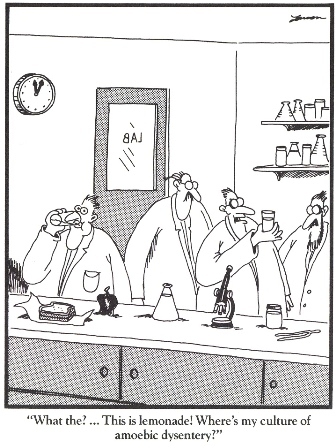
Okay, there is only one solution. I need a “Far Side” break! This cartoon, from my own copy of Gary Larson’s “Wildlife Preserves,” is an old (an oldie but goodie!) favourite of mine and will do just the trick. I hope you enjoy it, too!

Cellular psychopath

I am still reviewing my draft on the curcumin-esophageal study, which I hope to publish tomorrow. This morning I finally realized that I really needed a refresher on the complex process of mitosis, so I went online and found an incredibly easy-to-follow, less-than-13-minute explanation (in English) of the importance of mitosis in cancer. Two birds with one stone. In fact, three birds with one stone, since apoptosis is explained, too. Fantastico! Please have a look: http://tinyurl.com/ye8xdvy

Catchy!

I have received many messages from excited blog readers and MM list friends sending me links to different news reports on a recent study showing that curcumin kills esophageal cancer cells. Yep, I checked, the news that there is a new executioner in Cancer City is all over Internet.

Well, that should really come as no surprise to us, since for the past couple of years I have reported the same exact thing right here, based on what I have read over and over (and over!) in countless in vitro and in vivo scientific studies published in illustrious cancer journals. All of these studies show that curcumin kills different types of cancer cells…not just esophageal, but also myeloma, prostate (etc. etc. etc.) cells.

[The problem, of course, is how best to deliver an irresistible but lethal package of curcumin right to the doorstep of our cancer cells. As I have whined from time to time, if only we could inject this compound directly into the little buggers…! Well, this is an issue that I will discuss more in detail next week, when I publish my post on the above-mentioned esophageal study.]

I say, this should be a good lesson for researchers. I mean, just check out the title given to one of the key studies on curcumin and myeloma (=published in “Blood” in 2003): “Curcumin (diferuloylmethane) down-regulates the constitutive activation of nuclear factor-kB and IkBa kinase in human multiple myeloma cells, leading to suppression of proliferation and induction of apoptosis.” Helloo? Only scientists could possibly understand it. The rest of us are thinking: “Down-regulates the whaaat???”…“Induction of apotptotpoopywhaaat”?

Compare that mind-numbing (no offense intended!) title to these shorter, catchier ones: “Curry Powder Ingredient Kills Cancer Cells” or even to the title of the above-mentioned study: “Curcumin induces apoptosis-independent death in oesophageal cancer cells.” Yes, I think my point is clear…

Just for the fun (?) of it, let’s have a quick look at “apoptosis,” which means “programmed cell death.” This is actually a normal cellular process: cells are born, live for a while, do what they are supposed to do, then begin shrinking and eventually break up into fragments and die. There are a lot of videos online that show the process in a fun cartoon-like way, such as this one: http://tinyurl.com/cvtwjf (don’t miss the creepy sound effects!).   

But the normal apoptotic process doesn’t apply to cancer cells. Cancer cells are able to mutate and protect themselves from death in various ways. First of all, they blatantly ignore the normal cellular signals telling them, “okay tough guys, party’s over, time to die now.” Cancer cells thumb their noses at these signals and continue to grow, proliferate and do their pesky deeds…in fact, in the case of myeloma, they even recruit the body’s own immune system cells (specifically, plasmacyenergizer-bunny-page[1]toid dendritic cells) for protection (see my October 6 2009 post, or read this: http://tinyurl.com/ye6d5bu). They are sort of like that rather annoying Energizer bunny (il coniglietto Duracell in Italy), always on the go, go, go.

Conventional medicine uses harmful chemicals and radiation to stop the partying of cancer cells. But with most cancers, not just myeloma, that is not enough. Cancer cells eventually become resistant to these chemical attacks, with obvious consequences. And let’s not forget that our healthy cells are also affected in terrible ways by chemotherapy: some never recover.

Clearly, new strategies are needed. And, in my amateur opinion, these should, indeed must!!!, include non-toxic compounds that are able to: 1. protect our healthy cells from the toxic effects of chemotherapy and 2. increase the murderous anti-cancer effect of chemo drugs. There currently are a few clinical trials testing these chemo-compound combinations. It’s a start, but it’s hardly enough.

Well, this weekend is a busy one (in a good sense, eh!). I am switching off the computer. Have a good one, everybody!

Update on saw palmetto

I just finished reading a very technical study on a fascinating but VERY complex topic. When I saw that the study was only eleven pages long, I figured, “hey, no problem, I will have a first draft within the hour and publish the final version on the blog later today.” Uhmmm…that was three days ago! True, I have had plenty of other stuff to do (a translation for work and whatnot), but this particular study is a whopping headache-causer! Ever heard of “mitotic catastrophe”? Thought not. Well, my main problem right now is trying to toss the overly technical stuff that we do not need to know AND write the rest in a simple, intelligible way…easier said than done.

In the meantime, I thought I would publish a quick update on saw palmetto, or Serenoa repens, the anti-myeloma, non toxic substance that I am testing right at the moment (see my saw palmetto Page for more information). Things are going very well, and I have no ill effects to report…but I have noticed a rather peculiar phenomenon: my hair seems to be growing like mad! I mean, this is ridiculous.

Out of curiosity, this morning I looked up saw palmetto and discovered that it is given as a treatment for male baldness. Aha! Well, before beginning this experiment, I suppose I had ignored this, er, hairy side effect because: 1. I am not a “male,” and 2. I am the complete opposite of “bald” (I have always had very thick wavy hair). Too bad, or I might have taken “before” and “after” photos of my bushy, now bushier!, head of hair to publish on the blog. Too late now…you will just have to take my word for it.

Okay, I have to re-read my final draft now. Then I need to make an appointment to have my hair cut before it starts growling at my cats…

Hot spot kitty

Although my favourite Simon’s Cat video is still “Cat Man Do,” Simon’s new “Hot Spot” is amusing, too: http://tinyurl.com/y96ln4x

I think of the Cat Man Do video every time my boy Piccolo (who weighs at least 8 kilos) walks on my head in the early morning…that’s his not-so-subtle way of letting me know that I need to get up quickly and give him his breakfast…or else!

Funny baby videos

Lovely day in Florence today. I did some laundry, finished part of a translation that is due tomorrow, enjoyed the sun a bit (trying to soak in some vitamin D!) and took a photo from our attic window that I then posted as my current blog banner. It turned out a bit dark because of t2694689890043194007S425x425Q85[1]he rather blinding afternoon sun, I think (see how light it is on the left side of the photo)…I could have fixed it on the computer, but…I didn’t. You can still see how the leaves are changing colour. Fall has arrived in Firenze!

Now for a couple of funny baby videos. These were posted on Facebook by a myeloma list friend (thanks!)…I laughed until tears were streaming down my face and my tummy hurt, so you can’t say I didn’t warn ya! I will have to add them to my list of funny stuff…(oh, by the way, yesterday I managed to update some of my Pages…about time! Still lots to do, I know, but…better than nothing…!). Okay, ready for a laugh? Here goes:

Video 1 (my Mom’s favourite): http://tinyurl.com/yjyslzc  and Video 2 (my favourite): http://tinyurl.com/yekpf6f

How a virus invades the body…

Okay, recently I have been writing way too much about the flu and flu vaccines and flu prevention…so much so that I have begun to develop a few flu symptoms…! 😉

Seriously now, whenever you have a bit of free time, exactly 3 minutes and 39 seconds!, check out this really neat, well-made cartoon video depiction of what happens when someone who has the flu sneezes near you: http://tinyurl.com/yjpty3m No, I promise, the cartoon is not gross at all…on the contrary, it is absolutely fascinating!

By the way, Fanatic Cook is one of my favourite bloggers. I link to her blog…scroll down my Pages to “Useful food/spice-related links”….which is not at all an appropriate heading, come to think of it, since she doesn’t just post about food but treats a huge variety of topics, from vitamin D to genetically modified organisms and cancer… Check out her archives when you have some free time…good stuff!

Elderberry and H1N1

Now that I have decided not to have the H1N1 vaccination, I am looking around for natural ways to protect myself and my family. One very very promising substance appears to be elderberry (Sambucus nigra). It’s the same old tune: this plant has been used for ages in folk medicine to treat flu, colds and sinusitis. If you look it up on Wikipedia, you will find that it was shown to be effective for treating Influenza B. People using the elderberry extract recovered much faster than those only on a placebo. This is partially due to the fact that Elderberry inhibits neuraminidase, the enzyme used by the virus to spread infection to host cells.

Well, lo and behold, a July 2009 study showed that it was also effective against the horrid H1N1 virus in vitro: http://tinyurl.com/yh7gzef The elderberry extract blocked host cell entry and/or recognition. And read this: The H1N1 inhibition activities of the elderberry flavonoids compare favorably to the known anti-influenza activities of Oseltamivir (Tamiflu; 0.32 microM) and Amantadine (27 microM). Aha!

Here is a Medical News report about the above-mentioned study: http://tinyurl.com/nuumwe An excerpt: The research results are notable not only because they identified and characterized two specific flavonoids (plant nutrients that are beneficial to health) that are the major contributors to the anti-influenza activity of the elderberry extract, but also verified how the flavonoids provide that benefit, via direct binding to H1N1 virus particles and blocking the virus from infecting host cells.

This is nothing new, incidentally. I found a 1995 (!) study in PubMed, showing that a standardized elderberry extract, Sambucol (SAM), blocked the replication of human influenza viruses of various types, both A and B (the complete list can be found in the abstract: http://tinyurl.com/yhalylh). This extract was tested on a group of influenza B sufferers in 1993: A significant improvement of the symptoms, including fever, was seen in 93.3% of the cases in the SAM-treated group within 2 days, whereas in the control group 91.7% of the patients showed an improvement within 6 days. The abstract concludes: Considering the efficacy of the extract in vitro on all strains of influenza virus tested, the clinical results, its low cost, and absence of side-effects, this preparation could offer a possibility for safe treatment for influenza A and B.

And there is more: during the 1999-2000 flu season in Norway a study was carried out on 60 patients between the age of 18 and 54 with respiratory influenza symptoms. The full study is available online: http://tinyurl.com/d2sjl4 and is a good one to read, since it shows the efficacy of elderberry against influenza A and provides doses: Patients received 15 ml of elderberry or placebo syrup four times a day for 5 days […] during meals. The study concludes: In view of its in vitro and in vivo efficacy on influenza A and B viruses, elderberry extract offers an efficient, safe and cost-effective supplement to the present armamentarium of medications for the prophylaxis and treatment of influenza. It should be stressed that our study involved only adult influenza patients who were otherwise healthy, and did not include any high-risk patients.

I also found a study on the H1N1 virus and a resveratrol tetramer called “(+)-vitisin A,” isolated from the roots of Vitis vinifera: http://tinyurl.com/ykhlmv8 The abstract concludes that: (+)-vitisin A might be a potent anti-inflammatory agent that inhibits influenza A virus-induced RANTES production by interfering with Akt- and STAT (1)-related signal pathways. Might be. Well, I suppose a glass of red wine now and again wouldn’t hurt!

And here is a study on quercetin, mice, stressful exercise and influenza: http://tinyurl.com/yl6yejq Boy, this one really made me wonder…how can anyone come up with such a weird research idea? It was almost as weird as the one on testosterone levels during the 2008 U.S. presidential elections (just for a chuckle, see: http://tinyurl.com/yfw4pfs)

If you are not taking Velcade, it might be wise to increase your intake of green tea, see this 2005 study on EGCG and the influenza virus: http://tinyurl.com/yz26wuv

And how about tea tree oil? See this September 2009 study: http://tinyurl.com/yfmtmo7 A group of Italian researchers found tea tree oil to be effective against influenza A, subtype H1N1, at doses below the cytotoxic dose. They conclude that this essential oil should be a promising drug in the treatment of influenza virus infection. Interesting.

Well, it’s time for me to stop now. But I thought the news about elderberry was worthy of some attention. By the way, Sambucol doesn’t seem to be on the market here in Italy; earlier this afternoon I called a couple of local pharmacies and health food stores. No luck. Well, that didn’t deter me. I just ordered a couple of bottles from a UK website…to have on hand just in case…! (I know, I know, I just violated my policy of not mentioning brands on my blog…oh well! Pazienza…). Before I sign off, I would like to thank Hans who was the first to tell me about elderberry…

The multiple myeloma patient and family seminar in Florence. Part 2

During the question period, I made the point that non toxic plant extracts with strong anti-myeloma activity, such as curcumin and resveratrol (and the more than 20 other substances that I have listed on my blog, and who knows how many more I will come across…), have been studied in laboratory settings both in vitro and in vivo, but it’s about time to get those substances OUT of the lab and into clinical trials, if for no other reason than the fact that many of them increase the effectiveness of chemotherapy while protecting healthy cells from the damaging effects of chemo as well as reducing its toxic side effects. I mentioned a European clinical trial that is currently testing resveratrol alone or together with Velcade on myeloma patients (it began in June: http://tinyurl.com/yjqev5o). This is a positive start, I said, but it is hardly enough. I then asked what we patients can do to help get this process in gear quickly…didn’t really get an answer…a complicated issue, I know…

Dr. Durie, however, did remark that these plant extracts could “even treat” the disease, in the case of stable MGUS and SMM. He also reminded us that those taking Velcade should be careful about drinking green tea and taking vitamin C and alpha lipoic acid (incidentally, I posted about EGCG interfering with bortezomib in March 2009: http://tinyurl.com/yhtqvb5). He added that green tea aficionados don’t have to give up their tea drinking habit entirely, but can simply skip having green tea on their “Velcade days.” This may be good news to some of you…

Another interesting titbit. When asked about risk factors for myeloma, he mentioned a recent “Blood” paper on pesticide exposure, but he also said that one of his patients used to be on call 24 hours a day for 4-5 different companies. That meant that this guy had to carry around several different cell phones turned on at all times. Well, this man developed myeloma in the pelvis area, right where the cell phones had been resting…hmmm, gives some food for thought, doesn’t it? (I possess a heavy, ancient cell phone…in fact dinosaurs used to send text messages with it…but it is always switched off; I carry it in my purse and use it only for emergencies…)

There was also quite a lively discussion on the usefulness of PET-CT scans. Actually, I was the one to begin that discussion, based on a question that a friend of mine, who was not able to attend the meeting, had asked me to ask on his behalf. Dr. Durie said that PET can help us determine if the myeloma has become active, for example in the case of a sudden paraprotein increase. It follows that this test can be useful for those who are smoldering. I have to say, though, that I will NOT have radioactive sugar injected into my veins unless I really really REALLY have to! This is another item that I have added to the list of questions for my haematologist.

An Italian haematologist who works at Careggi university hospital also gave a speech. I was very pleased to hear her state that when myeloma is in a stable, smoldering stage, it is best NOT to treat. Early treatment, she said, doesn’t prolong survival; on the contrary, it could be deleterious because of the toxic side effects of chemotherapy. I will never forget that in 2005 my Careggi haematologist wanted me to have two cycles of Velcade and then an SCT in the summer of 2006 (this never happened, see below). That wasn’t very long ago. I am glad to see that things (may) have changed since then…

Speaking of second opinions, I want to describe a rather upsetting incident. A soft-spoken young woman, who was at the seminar on behalf of her father, a MM patient, told us that her father’s doctor got very angry and yelled at her when she told him at one point that she wanted a second opinion. Well, this sort of attitude on the part of any doctor/specialist is simply unacceptable. When we go to our doctors, we have to put ourselves and our health first. A second opinion, even a third, might save us from undergoing unnecessary treatments (etc.). I am a case in point: in 2005 I consulted three different MM specialists, two in the U.S., one in northern Italy, and they all told me that if I didn’t have any CRAB symptoms (I didn’t/don’t) there was no reason to begin chemo. Oh, and something else: if a doctor ever raised his/her voice with me, I would leave immediately and never ever go back. The very thought of that sweet young woman being mistreated makes my blood boil…

All in all, this was an interesting seminar, and I learned a few useful things, such as the serum iron/ferritin thingy. I also had the wonderful opportunity to speak privately with Dr. Brian Durie and Susie Novis and, separately, with Greg Brozeit, the director of IMF Europe. Dr. Durie wasn’t surprised to learn that curcumin has kept me stable now for the past four years. He told me, in fact, that a “subset of smoldering patients” does very well on curcumin. Indeed.

One of my favourite moments: in response to a patient’s question, Dr. Durie joked that “this just goes to show that myeloma treatment is an Art, not a Science…so you should be very good at this in Florence!” Chuckle, chuckle!