It always helps to reread studies. Yesterday I had a second look at a study on curcumin and bone resorption published in 2004 in the Journal of Immunology (http://tinyurl.com/ynuvw7), according to which curcumin may be helpful in treating secondary bone lesions associated with breast cancer and multiple myeloma and those associated with nonmalignant diseases like postmenopausal osteoporosis, Paget’s disease and rheumatoid arthritis… Researchers examined the effects of curcumin on RANKL, which stands for: Receptor Activator for Nuclear Factor-kB Ligand. Before proceeding, though, what does RANKL have to do with MM? MM cells can stimulate this receptor activator: the level of RANKL expression by myeloma cells correlates significantly with osteolytic bone disease. (See: http://tinyurl.com/36evhl) Therefore, news of any RANKL inhibitor is GOOD news. And it just so happens that, according to the abovementioned Journal of Immunology study, RANKL induces osteoclastogenesis through the activation of NF-kB, and treatment with curcumin inhibits both the NF-kB activation and osteoclastogenesis induced by RANKL. Perfect.
I also read about a 2006 University of Arizona study (head researcher: Dr. Janet Funk) on bone loss and curcumin, see http://tinyurl.com/28cpqj. Bone loss is a big problem in MM. The proliferation of MM cells reaches the point of inhibiting the regular functioning of bone-forming cells. As a result we may develop lytic lesions, which look like holes (!) and put us at a great risk for fractures, not to mention pain. Under normal circumstances, osteoclasts (about which I have written in my post on ginger) are cells that rebuild what is called fatigued bone, with the help of osteoblasts. In MM, osteoclast activity is increased (bad bad bad!), which causes bone loss instead of bone repair. (I don’t want to get bogged down in the details of this process, which is well explained here: http://tinyurl.com/2894en) I found another study with the same results, i.e., curcumin induces apoptosis of osteoclasts: http://tinyurl.com/2r38aa What is relevant for us MMers, and indeed for anybody suffering from osteoporosis, is that curcumin inhibits excessive osteoclast formation. Excellent! A few more feathers in curcumin’s rather large cap, I’d say.
Now, in all fairness, I also read a study (http://tinyurl.com/2jwu63) that seems to indicate that curcumin inhibits the proliferation and mineralization of osteoblasts. If proved true, this would mean that curcumin might have opposing effects, which, however, might end up annulling each other (I may really be going out on a limb, here! 😉 ). That is, no bone loss but no gain, either. Among other things, the following study indicates that arthritic rats treated with curcumin showed improved mineral bone density: http://tinyurl.com/2tlt38 It will be interesting to see future developments based on studies carried out on actual human beings instead of rats and cell cultures. Of course, since I have been taking 8 grams of curcumin for more than 16 months and my most recent skeletal survey showed no lesions, I have the feeling that Dr. Funk’s research will turn out to be the winner. The eternal optimist! 🙂
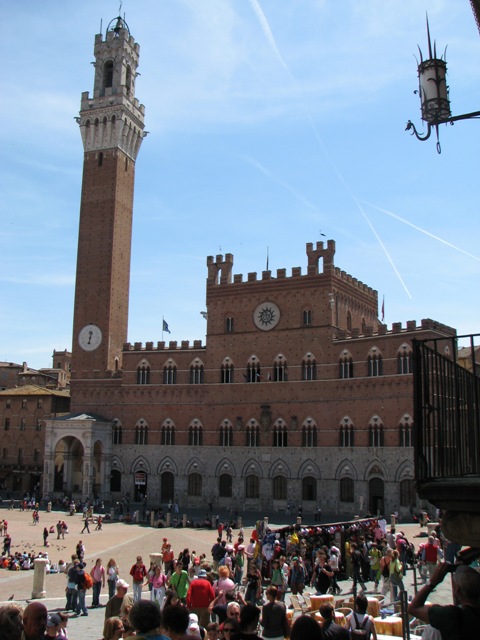 We spent a lovely day in Siena, yesterday. One of my best photos is of the famous 14th century Piazza del Campo, a shell-shaped square that slopes down toward the Palazzo Pubblico and the Torre del Mangia (the bell-tower). Yesterday it was packed with tourists, loudly chattering Italian school groups and people sitting (or lying) on the ground having picnics and reading books or newspapers, yet there was still plenty of space for us to walk around. Siena is simply gorgeous.
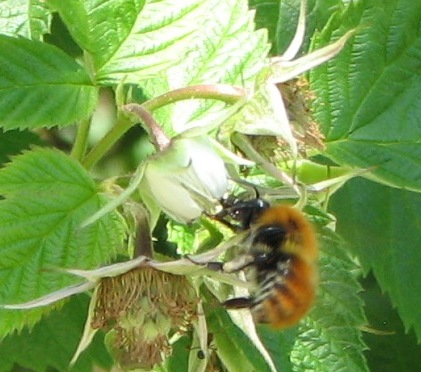 my camera-shy buzzing friend this morning, busily collecting nectar from my monster raspberry plant, which grew from a tiny half dead shoot that I brought back to Italy from my parents’ back yard in the U.S. a couple of years ago. Mr. Honeybee is a bit out of focus, but it’s the best I have been able to do.
 my
my