
Feeling Myeloma

My MMA list friend left yesterday morning for Venice. She will be back in Florence on Thursday. I would have loved to have accompanied her since I haven’t been to Venice in years, but I am teaching this week, oh well. Anyway, she is a truly wonderful person, and I feel as though we have known each other for decades instead of just a few days. Her visit has turned out to be a complete joy and has also been an eye-opener in many ways. I should mention that she is a professional therapist, and a very good one at that!, and perhaps that is why I find myself telling her things that even my closest friends don’t know. How does THAT happen??? Oh, and the funny thing is, she frequently doesn’t even have to ask me any questions. Words just start pouring out of my mouth. That’s never happened to me.

Today I want to write about one of those eye-opening discussions: feelings. Feelings, she said, are so rarely discussed on the myeloma listservs. I had never really considered that aspect of the myeloma puzzle. But she’s right: listserv members discuss treatments and symptoms and pain and so on, so why do we not discuss feelings on more than an occasional basis? The simple answer is, because it’s hard.

After giving the matter some thought, I have come to recognize that, when I do research, it is as though I am doing this for SOMEONE ELSE, not for me. I am not the myeloma patient when I don my researcher outfit. I become detached. Does this make any sense?

Perhaps my friend is right. Perhaps I keep my mind busy doing research so that I won’t have to deal with any feelings about myeloma. Even my blog, now that I think about it, may just be another way to avoid feeling. In my daily life I rarely think about myeloma, even when I take my curcumin twice a day. Sure, I visualize the malignant cells, but I probably don’t make the connection: those cells are PART OF ME. In fact, when I visualize them, they are outside my body. They have always been big slow hairy (no idea why I think of them as hairy!) stupid monsters that I slash and kill with my sword. Outside my body

This is a tough subject, and I am certainly not equipped to go into much, if any, depth, but it is also an interesting and perhaps very important one. My friend has given me lots of food for thought. At one point, she asked me if I had ever felt angry or if I ever feel angry, obviously in connection with myeloma. Angry? No, I answered immediately. How about sad, she asked? No, not at all. And fear? Well, yes, sometimes I do get scared, I admitted. Well, so what do you FEEL?, she insisted. I answered: I feel determined. But determination isn’t a feeling, she pointed out. It isn’t? Darn it, she is right. Merriam Webster defines determination as the firm or fixed intention to achieve a desired end. There is no emotion attached to determination (or is there?). So am I not allowing myself to have emotions about myeloma? But I DO have emotions, my brain protests. No, no I don’t, let’s be honest, not where myeloma is concerned. I have very few emotions surrounding myeloma. Of course, I strongly feel for and empathize with other suffering myeloma patients, but if I try to feel something for myself, I feel nothing. No fear, no anger, no sadness, no depression.

Final question for the day: are my cheerful attitude and quirky sense of humor simply a mask (in the sense of a Pirandellian mask)? I don’t think so, since I have been this way all my life, but I don’t know for certain. I have no definite answers, except that perhaps denial, if that is what it is, gives us a way of coping and trying to function on a daily basis. Perhaps it is not necessarily a bad thing…

Well, that’s it for now. Yesterday I discovered something new, so I have some research to do. 😉
MMA List Member Friend

When I signed up for two of the myeloma listservs more than a year ago, I met many wonderful people. Among them is a friend with MGUS, a curcumin-taker, who arrived Thursday in Rome. This is her first trip to Europe! She arrived in Florence yesterday and is staying with us. We hadn’t actually met until yesterday. Anyway, this is very very exciting!

After doing some sightseeing this morning, we returned home where I prepared my first curcumin mixture, my butter/curcumin/hot chocolate milk concoction. She tasted it and pronounced it very good. She was surprised. She thought it would taste terrible. She just told me, and I quote: “it tasted like pure chocolate, there was no aftertaste of curcumin.” I am quite pleased. 🙂

Anyway, we are busy, so I will stop here. More soon!

Ideas For Dissolving Curcumin

A blog reader recently sent me a fascinating message concerning the bioavailability of curcumin and his own experiments with curcumin. Since I believe that it is essential for us to be aware of what happens to curcumin once we swallow it, I would like to reprint parts of his message (divided into brief chapters). Here follow a few suggestions on how to dissolve curcumin powder. Some of these methods have been discussed on previous occasions:

I verified that curcumin will not dissolve in plain water, although if curcumin is added to water and then boiled it appears to dissolve. However, upon closer examination following cooling of the mixture it turns out that the clumps of curcumin crystals from the capsule were broken up by the agitation of the water and a suspension of fine crystals or tiny clumps of crystals was formed and its color and opaqueness suggested a solution existed. But then after time the suspended particles settled out, leaving essentially clear water and curcumin solids at the bottom. No curcumin actually dissolved.

Curcumin will rapidly dissolve in ethanol (ethyl alcohol) and in glycerine, which is a sugar alcohol, edible and sweet tasting. However, these two solutions will be digested differently than curcumin dissolved in the true oils, and are not the preferred way to get curcumin, in my opinion, as will be explained later.

But it is quite easy to dissolve curcumin in various edible oils. For example, curcumin from a 900 mg capsule would readily dissolve in one teaspoon (or 4 grams) of each of the following oils, with only a small amount of mixing: omega-3 fish oil, flax seed oil (which is another omega-3 oil), olive oil, canola oil, and clarified and warmed butter. Curcumin in warm butterIn addition, curcumin from a 900 mg capsule would readily dissolve in one melted dark chocolate truffle, weighing 18.3 grams and containing 8 grams of fat.
Curcumin dissolved in the warmed butter and chocolate present some interesting possibilities in taking your curcumin. For instance, I spread the teaspoon of cooled but still softened butter/curcumin mix on a piece of toast and it was very delicious and just a little tangy. How about pancakes, French toast? Also, the melted chocolate/curcumin mix was poured into a flat saucer and hardened in the refrigerator, then cut up into small rectangles that could be saved and then later popped into the mouth and swallowed whole, without even chewing. Needless to say, the chocolate mix was very delicious while in the mouth.

All of the oils with dissolved curcumin can be readily swallowed by the teaspoonful and vary somewhat in their taste and palatability and feel in the mouth. I very much prefer the fish oil, because it is virtually tasteless and easy to swallow. I use Carlson’s Very Finest Liquid Fish Oil and buy it in 500 ml bottles, a case of 8 bottles at a time from Lucky Vitamins, Vitacost, or whoever has the best price at the time. Once opened, the bottle is kept in the refrigerator to prevent oxidation and development of a poor taste.

When my curcumin, which I buy from Swanson’s Vitamins, was mixed in all six of the above fats and other two fluids I noticed that there were tiny little residual grains of hard stuff that did not dissolve, like sand. But they could be crushed up with the back of a spoon into finer particles, which still did not dissolve. This affects the palatability somewhat when the mix is taken by the spoonful, because you feel these small granules in the mouth. This gritty stuff may be unique to the Swanson’s curcumin, which is the standard 95% curcuminoids blend of curcumin and the other two curcuminoids. But maybe that remaining 5% is stuff that the Curcuma longa plant makes that is not soluble in any of the tested oils and alcohols. But I never even noticed the gritty stuff when eating my curcumin/butter toast or chocumin chip.

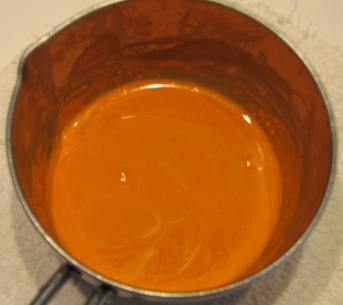
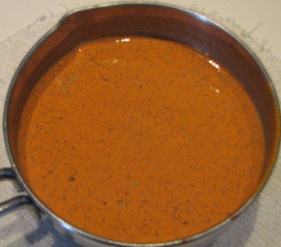
My own observations: like my blog reader, I have been stumped by the sand-like grains that don’t dissolve. Since I use the C3 Complex Sabinsa curcumin, grittiness would appear to be a common feature of curcumin. I too tried crushing the gritty bits with a spoon, but soon realized that it was pointless. As my blog reader suggests, however, these grainy formations do NOT occur when warm butter is used. Dissolving curcumin in warm butter has another benefit: you can skip the double cream and use milk instead (fewer calories!), if you plan to drink the mixture. Curcumin butter added to hot chocolate milkFirst, dissolve the curcumin in a bit of warm butter, not much at all, then slowly add the hot chocolate milk. Photo number 1 (above) demonstrates that curcumin dissolves perfectly in butter. No gritty remains. The second photo (here on the left) shows the end result, after the addition of hot chocolate milk. Both photos are a bit out of focus, I apologize. The second one doesn’t clearly show that the dissolved curcumin sort of floats on top, similar to what happens when you add a bit of oil to a glass of water. But I assure you that that is the case. By the way, in recent days I have been putting less chocolate into the mixture, which I find more palatable, oddly enough.

My concern about making chocolate lozenges would be curcumin degeneration. Heated up, then cooled in the fridge would that alter the healing properties of curcumin? No idea.

As for my reader’s suggestion to spread curcumin on French toast etc., my friend Don (see the link to his blog, Myeloma Hope, on the right-hand side of my homepage) tried adding curcumin to his morning oatmeal. Well, why not? I would dissolve the curcumin in a bit of butter first, then add it to the oatmeal. Since I love oatmeal, I may try that some day.

Life Without Chocolate is a Beach Without Water

I never thought I would tire of eating chocolate. Ever. Chocolate has always been as crucial to me as the sun is to flowers, Chocolat is one of my favourite movies in the world (of course, it helps that Johnny Depp is one of the protagonists, and I adore Juliette Binoche), and as soon as I was old enough to handle hot ovens on my own I taught myself how to make and bake chocolate desserts. The words Margaret and Chocolate have always been synonymous…

A true and proud chocoholic. Until two days ago.

After two weeks or so on the chocolate/double cream/curcumin drink, twice a day, I am getting sick of chocolate. Sick of CHOCOLATE??? Moi??? Impossible! My own father didn’t believe me when I gave him the news this morning. He thought I was kidding, But Margaret, come on, it’s CHOCOLATE!

Sadly though, it is true. If you were to offer me a slice of chocolate cake now, I would say no, thanks. Nope, not even a slice of Chocolate Devil’s Food Cake or of that scrumptious heavenly flourless chocolate cake that I make and that nobody can resist.

From what I have read and been told, the exact same thing happens to those who work in chocolate factories. I always thought that would be a great job, because new employees are frequently given access to as much chocolate as they want. Now I know why: they get sick of it after a while!

Of course, this won’t stop me from preparing and drinking this chocolate mixture until I have my next set of tests. I can be quite stubborn. The moment I have my tests, though, no more chocolate for at least two months!

Writing this post reminded me that some time ago I came across a Chocoholic Page, which has some great quotes. Here are a few: “1. There’s nothing better than a good friend, except a good friend with CHOCOLATE; 2. I never met a chocolate I didn’t like; 3. A guy found a bottle in the ocean and opened it. Out popped a genie who said he would grant the guy three wishes. The guy wished for a million dollars, and poof! there were a million dollars. Then he wished for a convertible, and poof! there was a convertible [I would like to note that wishing for a convertible AFTER wishing for a million dollars was perhaps not a very smart move ]. And then, he wished he could be irresistible to all women… poof! he turned into a box of chocolates [hehe]; 4. A day without chocolate is a day without Sunshine; 5. Note of Advice: put “eat chocolate” at the top of your list of things to do today. That way, at least you’ll get one thing done; 6. Research tells us that fourteen of any ten individuals like chocolate.” Hehe, I like that last one.

Computer Humour

Ok, I needed a break from molecules and genes and virus delivery systems. So today I looked up some fun stuff. These are supposedly real phone calls received by real computer help desks. If Stefano weren’t a computer genius, able to solve all of my computer woes, I might well be one of the customers on this list! Hehe.

Tech support: What kind of computer do you have? Customer: A white one…

Tech support: Click on the “my computer” icon on to the left of the screen. Customer: Your left or my left?

Customer: Hi, good afternoon, I can’t print. Every time I try, it says ‘Can’t find printer.’ I’ve even lifted the printer and placed it in front of the monitor, but the computer still says he can’t find it…

Customer: I have problems printing in red…Tech support: Do you have a colour printer? Customer: Aaaah…….thank you.

Tech support: What’s on your monitor now, ma’am? Customer: A teddy bear my boyfriend bought for me.

Customer: My keyboard is not working anymore. Tech support: Are you sure it’s plugged into the computer? Customer: No. I can’t get behind the computer. Tech support: Pick up your keyboard and walk ten paces back. Customer: OK. Tech support: Did the keyboard come with you? Customer: Yes. Tech support: That means the keyboard is not plugged in. Is there another keyboard? Customer: Yes, there’s another one here. Ah…that one does work…

Customer: Can’t get on the Internet. Tech support: Are you sure you used the right password? Customer: Yes, I’m sure. I saw my colleague do it. Tech support: Can you tell me what the password was? Customer: Five stars.

Tech support: What anti-virus program do you use? Customer: Netscape. Tech support: That’s not an anti-virus program. Customer: Oh, sorry…Internet Explorer.

Customer: I have a huge problem. A friend has placed a screen saver on my computer, but every time I move the mouse, it disappears.

Tech support: How may I help you? Customer: I’m writing my first e-mail. Tech support: OK, and what seems to be the problem? Customer: Well, I have the letter ‘a’ in the address, but how do I get the circle around it?

A customer called the Canon help desk with a problem with her printer. Tech support: Are you running it under windows? Customer: “No, my desk is next to the door, but that is a good point. The man sitting in the cubicle next to me is under a window, and his printer is working fine.”

And last but not least…

Tech support: Okay Colin, let’s press the control and escape keys at the same time. That brings up a task list in the middle of the screen. Now type the letter “P ” to bring up the Program Manager.

Customer: I don’t have a “P.”

Tech support: On your keyboard, Colin.

Customer: What do you mean?

Tech support: “P”…..on your keyboard, Colin.

Customer: I’M NOT GOING TO DO THAT!!!

Adenoviruses, CD40 and Myeloma

Well, it seems that I may stand corrected. In my October 8th post on CD40, I mentioned my doubts concerning the possible use of a modified cold virus delivery system for myeloma patients, but yesterday morning I read a few items that, hmmm, may have changed my mind. I will proceed in order.

All plasma cells express CD40, but that is not the case with all myeloma cells. According to a 1994 French Blood study (see: http://tinyurl.com/ywcyv4), two-thirds of myeloma patients express CD40. That means that one-third are CD40-. By the way, in case you had any doubt concerning the importance of CD40 for myeloma, read this excerpt: …patients with progressive myeloma present a high level of CD40 expression.

Regardless of whether your myeloma expresses CD40 or not, though, the important concept contained in a 2002 Blood study (see: http://tinyurl.com/ytv929) is that we should be able to stimulate our immune systems to react against the malignant cells if we are able to deliver a transgenic (genetically modified, basically) form of CD40L (= CD40 ligand or CD154) to either type of myeloma cells, whether it has CD40 on its surface or not. The study ends: because our results show that the interaction with CD40 antigen on tumor cells is neither universal nor required for the immune enhancement mediated by transgenic CD40L, the molecule may be of therapeutic value in both CD40+ and CD40- forms of the disease. So all bases are covered. Excellent.

Now, if we connect this study with the modified cold virus theory, we may have a delivery system, a system that is being tested in clinical trials for other types of cancer right now. I am getting to the good part, hold on.

I did research for and wrote this post after reading two very interesting Ph.D. thesis abstracts (Baylor University). The first, dated February 2007 (abstract: http://tinyurl.com/yqwr6l), is titled Anti-tumor properties of CD40 ligand when delivered as a transgene by the conditional replicative oncolytic adenovirus AdEH to breast cancer cells (try saying that out loud without stopping to take a breath!). The abstract informs us that a potential limitation of CD40L therapy is systemic toxicity. The good news, however, is that this toxicity can apparently be overcome by using an adenovirus, which is essentially a virus that causes upper respiratory tract infections.

Ahhh, a modified cold virus, perhaps? 😉

I have requested authorization to read the full text of the second Ph.D. thesis, dated March 2007 and titled: Growth inhibition of human multiple myeloma cells by a conditional-replicative, oncolytic adenovirus armed with the CD154 (CD40-ligand) transgene (abstract: http://tinyurl.com/25dsdk). The abstract informs us that for targeted delivery of CD40L, we have constructed a conditional-replicative adenoviral for delivery of the CD40L transgene (AdEHCD40L). So here we have a sort of Federal Express delivery van, that is, an adenoviral delivery system. The van is supposed to deliver a “lethal package,” that is, a genetically modified form of CD40L, called AdEHCD40L, to its CD40 “customer” located on the surface of myeloma cells. The delivered transgene, our FedEx package, then inhibits the growth of CD40+ human myeloma cell lines. Simply put, adenovirus plus modified CD40L equals no myeloma cell growth.

I admit that I am becoming a bit obsessed with these darned molecules. When I was a child, many many years ago!, I used to spend hours putting puzzles together. The more complicated and the more pieces there were, the better. Well, this molecule business is like a big virtual puzzle. Every day I seem to come upon a new piece of the puzzle. I will, however, stop before my brain melts.

Not yet, though!

Naturally Targeting CD40

Well, this CD40 project (see my October 8th post) is going to be time-consuming and involved, and I am not even sure how much headway I will make with it, as I am a linguist by trade, not a molecular scientist (sigh). Well, we will see. For now, I did discover that CD40 is inhibited by a few natural substances–and perhaps by many more that have not yet been tested in that sense–including parthenolide (PTL) and honokiol (HNK). Today I will focus on these two substances. Honokiol, by the way, in addition to downregulating CD40, was found to decrease IL-6 levels, a phenomenon that I had already discussed in my May 12th post on honokiol and multiple myeloma. For more information on these two substances and myeloma, please scroll down my Alternative Research Pages (right-hand of your screen). I would like to mention that I was able to consult the full version of the following (two) parthenolide and honokiol studies thanks to a dear friend (grazie, Sherlock!).

The first study (see abstract: http://tinyurl.com/27ag9l), published in 2002 in the Journal of Allergy and Clinical Immunology, examines the effect of parthenolide on dendritic cells (or DCs), which are immune system surveillance cells that originate in the bone marrow and control the functions of B and T lymphocytes. I looked up dendritic cells and myeloma and found that, according to an Italian study published in Blood in 2002 (see: http://tinyurl.com/22f9cp) , these cells are functionally defective or impaired in myeloma patients (trust me to be the bearer of good news, huh? Well, I wasn’t too thrilled by this discovery, either ). The Italian study also reports that IL-6 has an immunosuppressive role in cancer patients by inhibiting the development of DCs. The latter statement is off-topic (nothing to do with parthenolide, in other words) but worth mentioning, in my view, because the authors soon thereafter suggest that the IL-6 inhibition of dendritic cells may be the mechanism whereby myeloma cells escape recognition by our immune system. Food for (future) thought.

Back to the 2002 parthenolide study. It is very technical, which made it very hard for me to follow. At any rate, as the abstract anticipates, parthenolide was found to downregulate the co-stimulatory molecule CD40 in a concentration-dependent manner, which is important news for us. I am beginning to think that even though parthenolide is another blood-thinner like curcumin, it might be worth my while to give it a try. I intend to ask my haematologist if she has access to DMAPT (see my October 3rd post).

The second study deals with honokiol (see abstract: http://tinyurl.com/yqoyn6) and was published in The Journal of Immunology in 2007. It examines inflammatory conditions such as rheumatoid arthritis (RA) but contains information that could be relevant to myeloma and perhaps other cancer patients as well. Here are a few of the more relevant and understandable (!) excerpts: A number of conditions are associated with the chronic inflammation and elevated levels of TNF-alpha and IL-6 seen in RA, including heart disease and cancer. Although the gastrointestinal tract is one of the most common sites of such cancer induction, a similar mechanism can also been found in plasma cells, leading to lymphoproliferative changes, lymphomas, and myelomas. [TNF-alpha is a growth factor for myeloma, as is IL-6.] This statement offers nothing new to those of us who were already aware of the inflammation-cancer connection. The study goes on to explain, however, that CD40, a member of the TNFR superfamily, is a key costimulatory molecule in T-B cell interactions, promoting the up-regulation of inflammatory cytokines such as TNF-alpha and IL-6 and autoantibody production. [TNFR stands for tumor necrosis factor receptor.] Now, I don’t recall ever having read that CD40 can activate IL-6. Interesting. And definitely here we have another strike against CD40.

Treatment with honokiol inhibited the activation of both of these myeloma growth factors, i.e., TNF-alpha and IL-6. This sentence deserved its own separate paragraph!

In the study’s Discussion part, we can read that CD40-mediated B cell activation, a key component of CIA pathogenesis, was inhibited by HNK treatment, and TNF-alpha and IL-6 were diminished in a dose-dependent manner, without decreasing IL-4 or IL-10 secretion. The support of IL-4 and IL-10 production by HNK is particularly beneficial given the established anti-inflammatory effects of these two cytokines. [CIA stands for collagen-induced arthritis.] I looked up these two cytokines, which is one big reason why this post took forever to write!, and, of the two, IL-10 apparently promotes the proliferation of myeloma cells. So the fact that it is not inhibited by honokiol doesn’t seem to be such a good thing. [I should note that high levels of IL-10 are, however, beneficial in other types of cancer, e.g. breast cancer.] And indeed, if we take another look at the above-mentioned Italian study, we find that IL-10 is produced by myeloma cells and could possibily inhibit the “differentiation and function” of dendritic cells. But perhaps this negative factor for myeloma is offset by the other beneficial effects of honokiol, such as its ability to inhibit NF-kappaB: It is consistent with the anti-inflammatory effect of HNK on CIA to see the dose-dependent inhibition of the transcriptional activators NF-kB and AP-1 in B cells.

The researchers add that they saw an increase in the amount of IgM after treatment with honokiol, which may have resulted from the above-mentioned NF-kB and AP-1 inhibition. We already know about NF-kappaB, but I would like to point out that AP-1 is also an evil transcription factor. At any rate, since honokiol increases the levels of IgM, let’s have a quick look at this immunoglobulin: it is found on the surface of B cells and gets released into the bloodstream during the body’s initial response to infection. Hmmm, perhaps if my IgM levels had been higher than they are at present, I wouldn’t have succumbed recently to that stupid germ. Bring on the honokiol! 😉

There is much more information, but I think this post is overwhelming enough so I will stop here. I am also looking at a couple of other natural substance studies in connection with CD40 but don’t yet know if they will be relevant. Okay, I need a nap now. Just kidding! 😉

Curcumin for Cats

Today I have been again immersed in the CD-40 natural antagonist literature, but the post is still not ready. So, in the meantime, I have decided to post a couple of items on another topic that I am very interested in (for two obvious reasons!): cats and curcumin.

A blog reader who unfortunately has an ailing cat sent me a private message earlier today asking if I had ever heard of curcumin being given to animals. Well, it just so happens that I have. Another blog reader, Vince, treated his cat, diagnosed with myelofibrosis, a blood disorder, with curcumin. She is alive and well today. You can read Bella’s amazing story here: http://www.mo-driver.com/bella.htm

I would have no hesitation in giving curcumin to one of my cats in case of need. But how much curcumin? Well, my blog reader sent me a file about a kitty called Bud who was given curcumin to treat FIV (feline AIDS). The website is: http://goo.gl/KV4jg (updated in Jan 2012). The information on curcumin dosage is as follows:

“Because it stimulates bile flow, contraindicated if there is bile duct blockage or gall stones. Should be taken with food. to minimize irritation. One source places a therapeutic feline dose of curcumin at 50-100mg daily and cites 100mg/kg as a benchmark ulcerogenic dose in ‘animals.’ (Human dosage: 2000mg curcumin, 20mg piperine, divided three times daily; Bud’s Dosage: 225mg curcumin, 6mg piperine, divided three times daily between meals; second round, 200mg with piperine and 50 GDU bromelain, divided twice daily with meals.).”

My concern: six mg of piperine sounds like a lot for such a small dosage of curcumin. I wouldn’t give my cat that much. Indeed, I might even skip the piperine and try something else (some sort of fat that my kitty would find palatable).

I also found the following, which confirms the 50-100 mg/kg dosage: “At very high doses (100 mg/kg body weight), curcumin may be ulcerogenic in animals, as evidenced by one rat study. […] Feline dosages are in the range of 50-100 mg daily of curcumin and approximately one-quarter teaspoon daily if using whole turmeric.” (see: http://goo.gl/xQaxl)

I will look into this matter more closely once I emerge from the world of molecular science.

Bed Cats

Today I read studies on a few natural substances that inhibit the co-stimulating molecule CD40, but the post isn’t ready yet. Perhaps tomorrow.

Piccolo, Priscilla and Peekaboo together! October 10, 2007In the meantime…today it just so happened that I managed to take a few photos of three of our cats lying together on our bed. The missing cat is Puzzola, our eldest cat, who mostly inhabits the upper quarters of our house. I am trying to get a shot of the four cats together, but it’s very difficult. At mealtimes, they are too excited, jumping over one another and running around for me to get a decent shot. Oh well! This is close enough!
Quercetin and Curcumin Potion

I wanted to mention that a couple of days ago I began mixing quercetin powder with my chocolate curcumin “ganache.” By the way, I bought the quercetin powder from Supplemental Health Formulations (see Curcumin Brands/Sources for info on SHF) about a year or so ago.

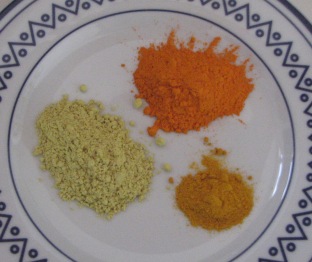
Quercetin powder and two types of curcumin powderHere is a photo portraying the three powders I threw into today’s brew. Left: two grams of quercetin. Top right: C3 Complex curcumin, four grams. Bottom right: SHF curcumin, one gram. I hope the photo is clear enough to show the difference in colour between the two types of curcumin.

As for flavour, well, this mixture tastes like a very rich (thanks to the double cream!) hot chocolate with a spicy edge. Very very nice. That is one reason why I hope that this method will work for me. 😉

Another, perhaps more important reason, one that I have mentioned on a previous occasion, is that mixing these powders into a liquid makes me feel a bit like Harry Potter putting together a healthful potion. It gives me a sense of active participation in the fight against my malignant cells. And, as I watch the powder dissolve and blend with the liquid, I have the time to visualize this mixture as it eventually encounters and kills some of my myeloma cells. I also like the feel of the thick drink as it goes down my throat, coating my tongue and painting it a rather bright shade of orange in the process. I know, I know, this must sound terribly silly. But I don’t get the same psychological feeling of power when I swallow curcumin capsules. Ahhh, it’s hard to explain. There’s only one thing to do: try it for yourself! 🙂