
Ranting and raving

I am still astounded at what I read yesterday in the October 1 newsletter of one of the main myeloma organizations. At first glance, I thought that the news item about denosumab, a monoclonal antibody currently under study for the treatment of osteoporosis and some types of cancer, including multiple myeloma, sounded quite interesting.

The title: “Amgen has positive results from Phase III trial of denosumab.” And the item reads as follows: Amgen announced results from a Phase III trial of denosumab in advanced cancer patients with multiple myeloma or solid tumors that showed the drug delayed the median time to first on-study skeletal related event by 4.3 months.

I wanted more information, so I clicked on the “read more” link. To my surprise, I was led DIRECTLY to Amgen’s own press release about denosumab. Huh? Hello??? Is a drug company’s press release considered to be an unbiased, reliable source of information? I mean, what if I based my blog research entirely on press releases and/or information from Heather’s Healing Herbs & Potions (=an invented company name, btw)? I think you get my point. Ridikkulus!

Well, I decided dig deeper. Let me make it clear that I had no idea that I would uncover any problems. But I did. Yes indeed, there may be some very serious problems with denosumab. Now, I don’t usually rant and rave, nor do I even like to rant and rave, but I think this deserves a bit of a rant.

It didn’t take me long to find a number of unsettling details concerning denosumab. See, e.g., this MedPage Today article titled “FDA Questions Denosumab Safety in Advisory Meeting Documents,” based on evidence from a denosumab-osteoporosis trial: http://tinyurl.com/ya6h99s

From the FDA report (taken from the above link): “Overall, subjects in the denosumab group had a slightly increased incidence of serious infections,” according to the briefing document. “There were more serious infections of the skin, ear, abdominal system and urinary tract. Also, endocarditis, infected arthritis and skin ulcers occurred more commonly in denosumab subjects. There were three denosumab subjects in phase I studies who developed pneumonia requiring hospitalization following a single dose of denosumab.” The document also noted that while Amgen did not perform carcinogenicity studies in animals because denosumab is not active in normal mice or rats, the clinical data showed a modest increase in certain malignancies in the human subjects. “Three subjects receiving a high dose of denosumab in [a] dose-finding study died of a new malignancy,” the staff review found. Those individuals received 100-mg doses, whereas 60 mg was used in the phase III studies and would likely be the recommended dose upon approval.

(I cannot quote the entire thing, but to read more just click on the above tinyurl link. Make sure you read the part about the “unhealthy changes in bone structure.” Oh, btw, let us not forget that, apart from having osteoporosis!, the trial participants were otherwise healthy women…)

The question is obvious: shouldn’t immunocompromised patients be informed of any potential problems, particularly the possibility of developing “serious infections”? Bloody hell, indeed we should!!! Infections kill so many of us…

But in the myeloma organization’s newsletter, and of course (duuuh!) in the Amgen press release, you will find nothing about all these potentially very serious issues for myeloma patients. Not one word. Hmmm, I just discovered also that Amgen is one of the MM organization’s corporate sponsors…no comment necessary…

To say I am disappointed is to put things mildly. I am bloody outraged! When our own myeloma organizations start using drug company press releases to provide us with important medical information, it is our duty to speak out.

This is rubbish, absolute rubbish.

Things have got to change. We can no longer afford to ignore the heaps of scientific studies that demonstrate the anti-myeloma effects of non toxic plant extracts. These compounds have the potential to improve the quality of our lives without harming us in any way (I am a case in point)…furthermore, many of them have been used for thousands of years in Ayurvedic medicine, that is, they already have a good safety profile.

For those of us who are stable, these compounds may slow down, or perhaps even halt!, progression to active myeloma. And heck, there may even be a cure for myeloma in there somewhere. But we will never know for sure, unless these compounds get tested, alone and in combination, in a clinical trial setting.

It is time for us to demand that the promising, non toxic compounds, such as picropodophyllin, be tested in MM and MGUS and SMM clinical trials. Not some day in the bloody future, but RIGHT NOW!!! 

[More details: http://tinyurl.com/ycap484]
IGF-1, the American mayapple, curcumin and multiple myeloma. Part II

First, I searched PubMed to see if curcumin possibly inhibits this growth hormone that has such a negative impact on myeloma patients. Hah. Quelle surprise! It does! So curcumin-takers are a step ahead, it would seem. Here are the two main studies:

  1. A 2008 study on colon cancer cells, chemo and curcumin (see: http://tinyurl.com/yajdk5s) found that the superior effects of the combination therapy of curcumin and FOLFOX are due to attenuation of EGFRs and IGF-1R signaling pathways. We also suggest that inclusion of curcumin to the conventional chemotherapeutic agent(s)/regimen could be an effective therapeutic strategy for colorectal cancer. (FOLFOX, btw, is a chemo regimen for patients with colorectal cancer.)
  2. A 2007 breast cancer cell (=MCF-7) study showed that curcumin exhibited a potent ability to blunt IGF-1-stimulated MCF-7 cell growth and reverse the IGF-1-induced apoptosis resistance. See: http://tinyurl.com/ye3jqje

I then checked out some of the other anti-myeloma, non toxic substances discussed on my blog. Bingo, again. Here is just a sampling of what I found:

  • 2009 study on resveratrol and genistein: Polyphenol treatments decreased cell proliferation and insulin-like growth factor-1 (IGF-1) protein expression in the prostate, see http://tinyurl.com/yesbb5q
  • 2008 study (see: http://tinyurl.com/yea69yn): resveratrol significantly inhibited IGF-1 in breast cancer cells.
  • The 2008 myeloma-parthenolide study that I posted about on June 4 2008 (see my Page on parthenolide or click here for the full study: http://tinyurl.com/ydousu2) shows that parthenolide, extracted from the feverfew plant, overcame the proliferative effects of cytokines interleukin-6 and insulin-like growth factor I, whereas the adhesion of MM cells to bone marrow stromal cells partially protected MM cells against parthenolide effect. (Blasted adhesion!)
  • 2009, prostate cancer-EGCG study (see: http://tinyurl.com/ydkbgw3). EGCG decreased the levels of IGF-1 (as well as having other beneficial effects). Same thing for colorectal cancer, see http://tinyurl.com/yat8wjt .

This post could easily turn into a long boring laundry list, so I will stop here. However, if you want to find out if any of the supplements that you are taking might inhibit IGF-1, just go to PubMed (general link: http://www.ncbi.nlm.nih.gov/) and type in your key words. Easy peasy.

Let’s move on. I would like now to discuss a Science Daily article that I read in September: http://tinyurl.com/ydxxcgm It gives us an overview of podophyllotoxin, an anticancer compound extracted from the roots and rhizomes of an endangered Indian medicinal plant but also from those of the common American mayapple (for an overview of this plant: http://tinyurl.com/yccs83x). This compound, incidentally, is found in the chemo drug etoposide, used to treat lymphoblastic leukemia, brain tumours and other types of cancer. The abstract of the study discussed in the SD article can be found here: http://tinyurl.com/nh4grx

As usual, I checked PubMed, where I found that picropodophyllin was tested in 2007 against myeloma cells, too. Hah! And, double hah!, the full study is available online: http://tinyurl.com/y8p4nzh The results are astounding: targeting the IGF-1R using picropodophyllin (PPP) in a therapeutical setting not only has strong antitumor activity on the established MM tumor but also influences the BM microenvironment by inhibiting angiogenesis and bone disease, having a profound effect on the survival of the mice. Wowie.

An important point: this study tested the impact of PPP in models of established myeloma, that is, not just on MM cells. They used what is called the 5T2MM mouse model, representing an in vivo model of established, slow growing myeloma. Now, you can read the details on your own (the study isn’t a difficult one compared to others I have encountered!), but let me give you just a few interesting results:

  1. PPP significantly reduced the tumor burden in the 5T2MM model. Up to 75% reduction in serum paraprotein.
  2. PPP reduced the accumulation of myeloma cells in the spleen by 70%.
  3. Mice treated with PPP survived 180 days…compared to the 100 days of the untreated ones.
  4. PPP also inhibits angiogenesis (good news for us).
  5. PPP may have a direct effect on osteoclast formation and osteolysis. It inhibits osteolytic lesions, a colossal problem in myeloma, as we know.
  6. The study concludes that blocking IGF-1R signaling with the receptor inhibitor PPP not only has a strong antitumoral effect in MM but also has a significant impact on the BM microenvironment, a key contributor to MM tumor expansion.

Let me point out that there are a couple of previous studies on the myeloma-picropodophyllin issue: a 2006 study (full text: http://tinyurl.com/yakrvy6) that I haven’t had the time to read yet, but that concludes that PPP targets the IGF-1RTK, blocks the IGF-1R function in vitro and in vivo, reduces tumor burden, and is associated with prolonged survival and this in the absence of apparent in vivo toxicity

The same edition of “Blood” has a study by the same group of researchers (full text: http://tinyurl.com/ydcqfl8), which comes to the same conclusions. I would like to highlight that PPP also decreased the levels of survivin and mcl-1, among other things.

I have more (strong) thoughts on this topic, but that is fodder for a separate post. Stay tuned!

IGF-1 and multiple myeloma. Part I.

This is not an easy topic. Therefore, I am going to divide it into two parts. In the first, I will make a feeble attempt to provide a brief description of IGF-1…focusing mainly on what it means for myeloma patients. In the second part, I will bring up a couple of things that we can do to give it a big whack…

IGF-1 stands for insulin-like growth factor 1. As its name implies, its molecular structure is similar to that of insulin, but its main purpose is not to decrease blood glucose levels but rather to stimulate the growth of normal cells (IGF-1 affects almost every cell in the body, I read)…and also–and here we get to the crux of the matter–the growth and survival of cancer cells.

Why am I interested in this growth hormone? Well, because in May I read a “Blood” abstract (see below), which showed that there is a connection between IGF-1 and myeloma cell proliferation…and this is not a super recent discovery, by the way. If you do a PubMed search, you will find studies on this issue that date back to the 1990s.

For instance, a 2000 French study (full study: http://tinyurl.com/ybwyngc) tells us that an important mediator of bone remodelling, IGF-1, has been shown to stimulate the proliferation of human myeloma cells. The researchers add that the mechanism involved is still a mystery…but after all, understanding the intricate workings of this process does not matter one whit to me…heck, I probably wouldn’t understand it anyway!

What matters to me is that there is a connection between IGF-1 and myeloma cell proliferation and survival, as we can read in a more recent (2008) study (abstract: http://tinyurl.com/kmbqcs): IGF-1 and IL-6 promote the proliferation and survival of multiple myeloma cells.

Sherlock (grazie!) sent me the full study, from which I took the following excerpt: the IGF-1 receptor (IGF-1R) is universally expressed on multiple myeloma cells, and higher expression levels are correlated with poorer patient prognosis. Okay, I admit that I merely skimmed the text, in part because I don’t have a huge amount of time, but also because this is an extremely complicated technical study, the splitting-headache kind….I finally had to set it aside and give up, at least for now.

Anyway, if you need more convincing that IGF-1 is bad news for us, here is the abstract to a May 2009 study published in “Blood”: http://tinyurl.com/ydl95ye Of the five myeloma growth factors (or MGFs) examined, IGF-1 was the major one…even worse, if possible!, than our old archenemy, IL-6. And here is a bad bit concerning prognosis: Of the investigated MGFs and their receptors, only expressions of IGF-1R and IL-6R in multiple myeloma cells (MMCs) of patients delineate a group with adverse prognosis. Ouch.

I should note that IGF-1 isn’t all bad. It is essential for normal growth and development (but of course we aren’t kids anymore!)…and I also found a study showing that it had a beneficial effect on cardiomyopathic hamsters: http://tinyurl.com/y99h3yo

Okay, but, in the case of multiple myeloma, high levels of IGF-1 = a bad thing. Clearly.

That’s it for today. More tomorrow, providing I can finish my research for Part II…

Last but not least: sweet little Jaymun, you hang in there! (see Jaymun’s journey)

Viva la ciccia!

My parents are leaving for the U.S. later today. I won’t see them again for months, but I don’t want to think about that right now…I want instead to write about what we did yesterday.

Yesterday morning Stefano suggested that we drive down to Panzano, near Greve in Chianti…if that means nothing to you, well, it’s in the heart of Chianti wine territory, roughly halfway between Florence and Siena. Typical Tuscan scenery—olive groves, rolling hills, old farmhouses, ancient turrets, vineyards…lovely, still not too spoiled…

We had lunch at a restaurant managed by Dario Cecchini and his family. Cecchini is “perhaps the most famous butcher in the world,” according to Anthony Bourdain (see: http://tinyurl.com/dgldnv). Certainly the most famous in Italy. His restaurant is called “Solo Ciccia,” which means “Only Meat” in the Tuscan dialect.

It came as a surprise to us that everyone sits together at the same table, just like an extended family. Our “family” consisted of a U.S. couple from Chicago and three Tuscan nuclei—an elderly couple, a young couple, and three women (mother, daughter, aunt). By the time the first platters of food arrived, we were all chatting, in English and Italian. Lovely.

I forgot to take photos of the different types of food we ate, mostly meat-based of course…more than ten platters of mouth-watering food…batter-fried meat and veggies, braised and roasted meat etc., accompanied by a truly outstanding Chianti red wine…oh, and, while we were having olive oil & pine nut cake with grappa and other liqueurs at the end of the meal, the butcher-poet himself made a quick appearance to say hi and make sure that we had eaten enough and were having a good time…a man of huge charisma, that Dario Cecchini!

We spent a total of two hours at the table…the restaurant has a fixed price, and you cannot choose single items from a menu. You have to eat whatever is brought to the table, but I assure you that we ate and ate and ate until we could eat no more. And the woman who served us this incredible amount of food kept accusing us of not being hungry and pushing us to eat more, just like a stereotypical Italian mamma

IMG_3020If you are travelling to Tuscany…well, this is an experience that I would highly recommend…unless you are a vegetarian, of course!

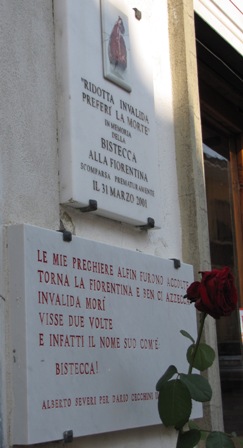
P.S. My photo depicts two marble signs posted outside Cecchini’s butcher shop. The one on top commemorates the “demise” of the famous Florentine T-bone steak, the thick and delicious “bistecca alla fiorentina,” which occurred in 2001, when certain cuts of meat were banned as a result of the mad cow scare that swept Europe in the late 1990s. I remember news reports showing hundreds of steak lovers attending Panzano’s mock funeral procession for the bistecca. The ban was lifted five years later, a fact that is gleefully celebrated in the second marble plaque (brightened by a real red rose).

(Plaque 1: “ridotta invalida, preferì la morte.” In memoria della bistecca alla fiorentina, scomparsa prematuramente il 31 marzo 2001. Plaque 2: Le mie preghiere alfin furon accolte. Torna la fiorentina e ben ci azzecca. Invalida morì, visse due volte. E infatti il nome suo com’è: bistecca!)

Laughter and allergies

“Lucy…I’m hooome!” Yes, my computer is fixed…it works perfectly…in fact, even better than before! Yaaay! Oh, okay, actually, to be honest, my genius of a husband fixed it a couple of days ago, but I took some time off and had some fun with the family over the weekend. More on that tomorrow…(grin)…

Anyway, I just finished reading a fascinating article concerning the effect of laughter on various ailments, mainly allergies, written by Jacob Schor, a naturopathic doctor with a practice in Denver (I subscribe to his excellent newsletter). Click on this link to read it: http://tinyurl.com/yeawx43

I would like to add that, as we know, 1. myeloma cells proliferate like mad in the presence of stress hormones, (see my “myeloma and stress” page: http://tinyurl.com/ydxrc83), and 2. laughter is a well-known stress-reliever…it doesn’t take much to put…one and two together. I am so convinced of the healthful benefits of laughter that I have devoted an entire section of my blog to funny videos and jokes and other silly whatnots (just scroll down my Page list on the right until you reach the heading “Laughter and MM”). 

I laugh a lot…but after reading this bit of news, I want to laugh even more! (…remember Norman Cousins and the Marx Brothers?)

Atchoo!

Well, my computer’s slight sniffle (=what seemed to be a small, easily fixable problem) has turned into a rather violent sneeze fest. The new hard disk turned out to be incompatible with the floppypoppy, which then screwed up the schloopyloopy, and then the snappynappy didn’t work anymore. As you can see, I have no clue as to what happened. All I know is that for the past couple of evenings, after work, my poor Stefano has been taking my computer apart and putting it back together under Peekaboo’s careful supervision (awww, sooo cute!). Last night, my hero finally solved the snafu, whatever it was!, but he didn’t have time to re-install all my data. He will do so tonight…that is, if there are no more atchoos!

He told me to use his mega-super-technologically-advanced computer today…but, without my files, e-mail, etc., there is really no point. So I will focus on other things, which is not a bad idea sometimes…

I hope to be back “in business”…tomorrow! Ciao!

I’m an ailurophile…

Day before yesterday a blog reader sent me the full study on curcumin and myeloma cells’ multidrug resistance…yaaay! Then this morning another blog reader did the same, joking that it had actually not yet been translated but was still in the original Chinese (haha…well, yes, I admit, it is not at all an easy text to read…), but I haven’t had the time yet to transla…er, I mean, read it through carefully enough to write a draft. Perhaps tomorrow…

Today I have time only for a quick post before Stefano takes my computer apart (these things always makes me jittery, even though he is a computer genius and always creates backups of backups…of backups). There is something wrong with one of my hard disk drives…no biggie, he can fix it easily. It will just take all afternoon.

So I thought this would be a good day to tell you that I just found out I’m an “ailurophile.” How about that? Hmmm, might you be an ailurophile, too?

Yesterday I saw that Richard Lederer, of “Anguished English” fame, has written two new books, one for dog lovers, one for cat lovers. It is here http://www.verbivore.com/adven.htm that I first clapped my eyes on the word “ailurophile,” IMG_2950which, I now know, means “cat lover” (in ancient Greek, ailouros = “cat”). Hey, try saying “ailurophile” ten times fast! Tee-hee.

The above link has some interesting statistics on cats and dogs in the United States…how many people have dogs and cats, e.g., how much they spend on pet food and so on. I am not that surprised…

Like the two ailurophiles in Richard Lederer’s Introduction, I buy only the best food for my cats. But I don’t buy cat food in a regular supermarket. Nope. I go to a specialty pet store…where by now I am friends with the two ailurophile/cynophile owners.

And yes, I still occasionally waste money on cat toys, even though I am well aware that my kitties are probably going to show complete indifference…and I will be the one chasing after the new toy. When we are away, I coo to my magical, mystical cats over the phone sometimes. And I take more photos of them than of anybody/thing else. The list goes on.

As I have written before, cats also have a positive effect on our health and longevity: Studies show that owning a cat alleviates loneliness, anxiety, and depression; reduces stress, high blood pressure, and heart disease; and adds six months to the average person’s life. Well, even though I have cats for reasons other than my health, it is lovely to know that they are adding months to my life…! Now, if only they could cure cancer…

Busy with work but still trying to keep updated…

I have been very busy with a translation that was due today, pant pant, so I have had to ignore all the stuff that has been piling up on my desktop in the past few days…studies screaming to be read, blog drafts clamoring to be finished…you get the picture. I have to ignore their pitiful little cries…but I could not ignore this juicy morsel: http://tinyurl.com/ngvc3q

A bell went off in my head…but, since I cannot remember the content of all of my posts (hundreds, by now!), I had to do a quick search of my blog to make sure that I hadn’t already posted about this study, a study on the synergy of curcumin and melphalan and on the ability of curcumin to overcome multidrug resistance. Well, I had. The original study was published in January 2009 in Chinese…in a Chinese journal. I posted about the English-translated abstract on July 2nd, 2009. If you would like to see what I wrote back then (not much, actually), click on http://tinyurl.com/l5j5ch

But this time there is a difference. It would appear, in fact, that the study has been translated into English…yaaay! Therefore, if I am able to get my hands on it AND if it has indeed been translated into a language that I am familiar with, I will write a report about it…sooooon, I hope!

Smiling…

Many thanks to a blog reader for sending me the link to a video about the adorable kitty traveling with a young French couple from the U.S. to the southern tip of Argentina (see my September 12th post): http://tinyurl.com/poso46 I also watched a longer documentary in French about this unusual journey, with more cute footage of the super duper kitty: http://tinyurl.com/qs9go8 These videos put a huge smile on my face after I got home from work today…I hope you enjoy them as much as I did! 🙂