Balls!

My black and white cat, Piccolo, is obsessed with balls. He joined our family about three and a half years ago, when he was five months old.
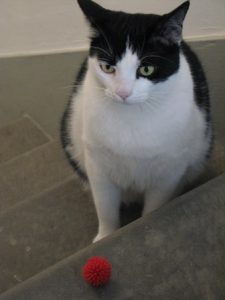
He was small for his age, so we named him Piccolo, which means little in Italian. As fate (or diet) would have it, my Piccolo is now a big boy. He must weigh at least eight kilos (about 18 lbs).

From the very beginning, he wanted us to throw balls, which he would retrieve and bring back to us to be thrown again. And again and again. As a kitten, he never seemed to tire of this game (we did!).

Our bedroom faces the staircase. At night, Piccolo will still bring me a ball and eagerly wait for me to throw it down the stairs. He then shoots off the bed and down the stairs like a furry rocket, but within a few seconds he is back, spitting the wet-with-cat-drool ball into my lap, as proud and happy as though he had brought me a hot cappuccino and brioche (my secret dream…).

At least twice a day he brings me a ball when I am in my study. If I ignore him, he will reach up and tap me on the arm. If I continue to ignore him, he will become a bit more insistent, digging his sharp little claws into my arm or leg. Then, when he starts getting tired of the ball game, he will begin dropping the retrieved ball farther and farther away from my desk chair, so I have to get up in order to toss it down the stairs.

Like most Italian kids, he loves to play soccer. He frequently waits on the stairs (see photo) with a ball placed in front of him. He will call your attention to the ball, which you are supposed to kick towards him so he can try to stop it from flying down the stairs. Sometimes he jumps up high and catches the ball in both paws, like an acrobatic goalkeeper. Indeed, we should have named him Gigi Buffon, in honour of the Italian soccer team’s world-class goalkeeper.

Piccolo frequently walks around the house carrying a ball in his mouth. When he encounters one of us, he will drop the ball, always ready to play. He is a clean boy, and will often drop his balls into the cats’ water bowl to give them a wash. Of course, he then forgets to take them out of the bowl.

He has also been known to leave a few balls in the kitty litter boxes…

Piccolo is a wonderful but rather heavy lap cat. When I am in bed, he will lie on me for hours, purring or sleeping or looking at me in adoration. As soon as I finish dinner, he will jump into my lap. Whenever I sit down, he seems to be in my lap.

He is a big talker, too. He chirps and makes weird un-catlike noises, telling me how he feels about things. I don’t really understand, but will helpfully chirp back. He likes to bump foreheads with us before mealtimes from his perch above the kitchen counter. Bump bump bump. When he wants to get my attention, he will sometimes give me a gentle slap in the face, no claws. Piccolo also enjoys leaping after flies and jumping on top of the furniture.

But, most of all, he loves playing ball.

Curcumin and Immune Disorders

This morning I read the most recent article sent to me by a member of Prof. Aggarwal’s team at the MD Anderson Cancer Research Center in Texas (for more information on these curcumin-related mailings, please leave me a comment here). Today’s article, titled ‘Spicing up’ of the immune system by curcumin, was published in the January 2007 edition of the Journal of Clinical Immunology. The abstract can be read at: http://tinyurl.com/2734me The study focuses on how curcumin affects the immune system, and more than reinforces my conviction that, whenever possible, ALL cancer patients should be taking curcumin (see my Warning section for counter indications). Indeed, healthy people should be taking it (at low doses), or should be using the spice turmeric in their cooking. Why? Because curcumin PREVENTS illnesses of all kinds. Not just cancer. Have a look at the following list, which, sorry!, does repeat a few of the things that I have written in other posts (last month’s Curcumin, a Panacea? ), but hey, repetition is not necessarily a bad thing.

Study excerpt: [ ] Turmeric has been used as a non-toxic drug in Ayurveda for centuries to treat a wide variety of disorders including rheumatism, body ache, skin diseases, intestinal worms, diarrhea, intermittent, fevers, hepatic disorders, biliousness, urinary discharges, dyspepsia, inflammations, constipation, leukoderma, amenorrhea, and colic. Turmeric has been considered as an emmenagogue, diuretic, and carminative when taken orally, whereas topical application is commonly used to treat bruises, pains, sprains, boils, swellings, sinusitis, and various skin disorders. Turmeric is used to treat angina pectoris, stomach-ache, postpartum abdominal pain, and gallstones in the Chinese system of medicine. It seems to promote the qi flow, stimulates menstrual discharge, and relieves menstrual pain. The poultices prepared from turmeric are topically applied to relieve pain and inflammation. A mixture of turmeric powder and slaked lime is applied topically as a household remedy to cure injury-related sprains and swelling. Turmeric is also an effective household remedy for sore throat, cough, and common cold, where it is taken orally with tea or hot milk.

Study conclusion: Curcumin primarily exerts its therapeutic effects by inhibiting the degradation of IκBα and subsequent inactivation of NF-κB, thus initiating a cascade of downstream inflammatory and immunogenic events. Curcumin’s inhibition of NF-κB activation, in turn, leads directly to the inhibition of expression of a number of proinflammatory cytokines (e.g., TNF, IL-1, IL-2, IL-6, IL-8, and IL-12) and downregulation of the mRNA expression of several proinflammatory enzymes (e.g., COX, LOX, MMPs, and NOS). In addition, curcumin’s immunogenic response is further enhanced by its ability to inhibit TLRs. Finally, curcumin exerts proimmune activity in several autoimmune disorders including Alzheimer’s disease, multiple sclerosis, cardiovascular disease, diabetes, allergy, asthma, inflammatory bowel disease, rheumatoid arthritis, renal ischemia, psoriasis, and scleroderma. Overall, these findings suggest that curcumin warrants further consideration as a potential immunoregulatory treatment in various immune disorders. Overwhelming, to say the least.

My personal experience. I have no doubt that curcumin has brought down my IgG count and is keeping my MM stable, which of course is my main purpose in taking it every day. However, curcumin has also given me many unexpected side benefits. For instance, I no longer have asthma, allergies, body aches, constipation and menstrual pain. Curcumin has also helped me improve my memory. In the pre-curcumin era, I used to forget everything, and had to write important things down. Then I would forget to read my notes! In a word, I was a scatterbrain (however, this could also be imputed to my high levels of blood viscosity, which have since decreased). Now I find it easier to remember things; even my husband has noticed a big improvement in my mental acuity. Plus, compared to the pre-curcumin era, I haven’t had any night sweats, and my night-time peripheral neuropathy (PN) has almost completely disappeared (it returns only on occasion, usually after I have eaten foods I normally avoid, like sugar). I have mentioned elsewhere that my cholesterol levels, which used to be very (very!) high, are now practically normal. So, you see, I have many good reasons to be curcumin-obsessed… 🙂

P.S. Yesterday I added my EGCG page to my Pages section (right hand of your screen). It has more information and study links compared to my EGCG posting. I also found a couple of interesting studies on EGCG and resveratrol used together with chemotherapy.