Today I’m going to post a few of our puffin photos. These birds are  extraordinary creatures, rather clumsy walkers, too (see the rather out-of-focus but amusing photo on the left), very entertaining to watch.
We spent more than two hours on Inner Farne Island, off the coast of Northumberland (Seahouses), where we saw a huge number of puffins and also the burrows that they had dug using their beaks and feet, like the one on the right.
Puffin burrows are about as long as a  human arm, I learned from a BBC morning program (mentioned in a blog comment by Paul) showing a Farne Island warden shoving his arm down a burrow and bringing up a rather ruffled puffin. Not a pleasant or easy thing to do, he remarked, because puffins aren’t as harmless as they look but will bite and scratch and struggle like mad. Well, I think I’d do much the same if I were being grabbed suddenly from above!
By the way, puffins are hygienically-minded creatures: they have a separate toilet area for their chicks inside the burrow. How about that? Well, okay, there is a good reason for the separate powder room: if the chick got itself all covered in…well, in you-know-what!…it might damage the waterproofing properties of its feathers. Since puffins spend most of their time out on the Atlantic ocean, you can see that that would be a huge problem!
 I should mention that there are three puffin species. The one depicted in this post is the Atlantic puffin. Atlantic puffins aren’t very large, about 30-34 cm long and 18 cm high. They weigh about 500 grams, and their wingspan measures about 50-60 cm. That means that when they fly you can’t see their wings at all, they are flapping so fast.
It is impossible to describe adequately how peculiar this looks. Puffins in flight look like zooming black and white footballs with some orange-coloured chewing gum stuck on one end. I read that these amazing sea birds flap their wings up to 400 beats per minute. Their wings are powerful but made more for swimming than flying.
And they go sooo fast! Taking a photo of a flying puffin is like trying to take a photo of a flying bullet. I have dozens of photos of tiny blurry dots in the sky (or just of the empty sky, sigh). Stefano, whose camera is much more sophisticated than mine, was able to take quite a few good ones, though, like the one on the right. Of course, you can actually see the wings 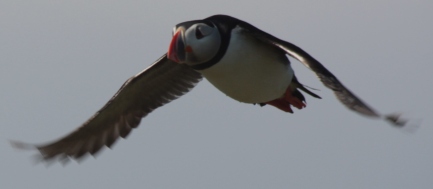 in a still photo, but I assure you that, when seen live, the wings are a total blur.
Anyway, at one point I simply gave up trying to take THE perfect photo, turned off my camera and stood in the middle of the small island watching puffins whiz right past me, above my head and all around me. If I had reached out, I would have been able to touch a few of them, they were that close. It was an amazing experience.
We saw tons of puffins out on the water, diving under the surface (I read that they can go as deep as 70 metres, or 200 feet), floating about or flying low above the water or landing on the water (on their stomachs, from what I could tell). 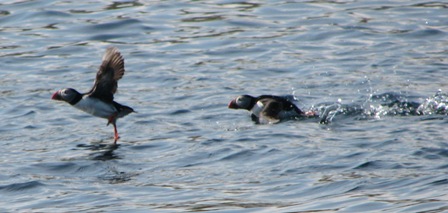 What a sight. We took photos, but most of them came out rather blurry (drat!). This one, though, shows how puffins are able to take off from the water surface. They start moving their little legs faster and faster while madly flapping their wings, looking a bit like comical cartoon characters, until they are finally able to lift their rather plump little bodies up into the air.
Well, we were very lucky to be here on such a glorious day. The owner of the boat who took us to the island told us that there were currently 13,000 puffin pairs there. According to the BBC program I saw, a total of 60,000 pairs are expected to nest on these islands this year.  I would like to mention that we also saw hundreds of other sea birds. I read that the Farne Islands host 182 other bird species, from razorbills to shags (see my photo of a nesting shag) and whatnot. Quite a sight. Oh, and the noise!, mamma mia!, mainly from the squacking and screeching sea gulls (I guess). Almost deafening.
You can read more about the Farne Island puffins in this May 2, 2008 Times article: http://tinyurl.com/3p43uf
As you can see, I am still in my holiday mode! 
 I won’t post the photo I took, since the one on the website is a much better one.
 I have never ever seen so many lambs (or sheep) in my entire life! Thousands. I kid you not. Or rather, I lamb you not!
  I think I may have more photos of lambs and sheep than of puffins, if possible. Adorable creatures.
 of modern-day England (source: Wikipedia). Even though it is a ruin, the wall is still very impressive and offers spectacular views of the surrounding countryside. Such as the one on the right.
 Well, we’re hooooooome…!
  So far, the only ones who are not happy that we are going off on holiday are my four beloved cats. Especially Priscilla (my second-youngest), see photo. Oh no, she is definitely not pleased.
 Well, Stefano and I are leaving tomorrow (early afternoon) for Northumberland. Ooooh, I am sooooo excited!!! Puffins, here we come!
 The first (above, left) depicts her meditation pose. Before doing any qigong exercises, she indictates, it is important to relax and meditate for a little while.
 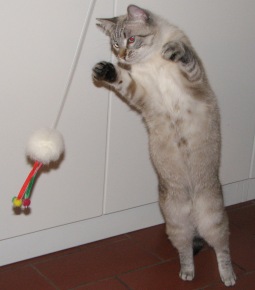 Photo number three (above, left) gives a demonstration of just how far to the side you can go with this particular qigong exercise. By the way, I would not recommend it to those who suffer from sore backs…
  Sherlock and I went to the hospital lab for blood tests very early this morning. We have been testing EGCG (in association with the ever-present curcumin) for the past seven weeks or so. Test results in mid May.
 Anyway, I will have another look at the study tomorrow morning, as I begin quietly, so as not to freak out the cats, assembling the stuff we need to pack for our trip to the UK (we leave on Friday!).
 be done. This was a team effort, actually, since Stefano did all the graphics for me. I merely (!) translated the text. Now we have to reread it and make sure it makes sense. The worst is over.
  Yesterday I was offered a big translation that I couldn’t refuse to do. Mainly, let’s be honest, because we need the extra bit of money (all that cat food adds up, y’know
  Let me highlight this sentence: Notch inhibitors attack cancer stem cells.