This is going to be a busy work week for me, so I probably won’t be able to spend much time doing research and writing. I have some extra translating work to do, which is good for our household budget, of course…
 But I will continue to find time for my daily readings. Here are some of the most interesting ones:
A “Guardian” article titled “Coping with cancer: you, me and the big C.” Three different stories about cancer…three different perspectives: http://goo.gl/CKq9P Well-written and moving. And a mention of curcumin in the first one, too.
A “Mail and Guardian” article on cancer-busting foods: http://goo.gl/AXlM8 I love looking at food lists. You never know what you might find in ’em. 🙂 To my surprise, this particular one mentioned margarine as “a healthy option.” Say whaaaaat? I’ve always avoided margarine like the plague. How can it suddenly be a “healthy” choice??? Any thoughts?
But this article intrigued me mainly because it lists Rooibos tea among the cancer fighters. I hadn’t even heard of this tea until recently. But now, whenever I’m home in the afternoon, I like to have a cuppa. Well, this article states that Rooibos tea boosts glutathione levels. Hmmm. That triggered a vague memory in the back of my mind: isn’t it bad to boost glutathione levels in myeloma? I tried looking that up but found way too much information for the little free time I have. However, I did find this: according to Dr. James Berenson’s 2004 “Biology and management of multiple myeloma,” glutathione levels are increased in melphalan-resistant myeloma cells. Increasing one’s glutathione levels would therefore appear not to be a good idea for those on melphalan. But what about the rest of us? Should I stop drinking this tea? Does anyone here have any thoughts/advice/etc.? Help! 🙂
 While I was looking for more info on glutathione and myeloma, I came across this 2009 study, which shows that myeloma patients have reduced levels of antioxidants: http://goo.gl/f7zYs Now, that’s INTERESTING, and I quote: MM is closely associated with oxidative stress and reduced antioxidant capacity. Aha. Food for thought…
More than 60% of Americans get their health information online, according to this Science Daily article: http://goo.gl/fC9RP But How might information accessed online affect individual health decisions? In my case, A LOT! 🙂
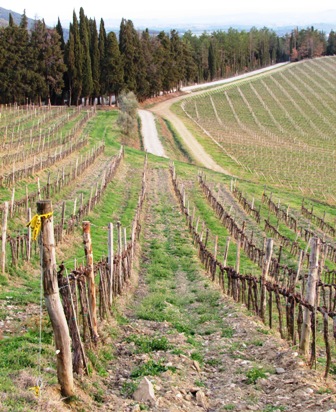
P.S. Today’s blog photos were taken in a vineyard behind the Castello di Brolio, near Gaiole in Chianti, on Saturday.