A blog reader recently sent me a fascinating message concerning the bioavailability of curcumin and his own experiments with curcumin. Since I believe that it is essential for us to be aware of what happens to curcumin once we swallow it, I would like to reprint parts of his message (divided into brief chapters). Here follow a few suggestions on how to dissolve curcumin powder. Some of these methods have been discussed on previous occasions:
I verified that curcumin will not dissolve in plain water, although if curcumin is added to water and then boiled it appears to dissolve. However, upon closer examination following cooling of the mixture it turns out that the clumps of curcumin crystals from the capsule were broken up by the agitation of the water and a suspension of fine crystals or tiny clumps of crystals was formed and its color and opaqueness suggested a solution existed. But then after time the suspended particles settled out, leaving essentially clear water and curcumin solids at the bottom. No curcumin actually dissolved.
Curcumin will rapidly dissolve in ethanol (ethyl alcohol) and in glycerine, which is a sugar alcohol, edible and sweet tasting. However, these two solutions will be digested differently than curcumin dissolved in the true oils, and are not the preferred way to get curcumin, in my opinion, as will be explained later.
But it is quite easy to dissolve curcumin in various edible oils. For example, curcumin from a 900 mg capsule would readily dissolve in one teaspoon (or 4 grams) of each of the following oils, with only a small amount of mixing: omega-3 fish oil, flax seed oil (which is another omega-3 oil), olive oil, canola oil, and clarified and warmed butter. 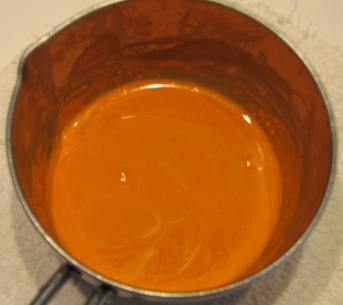 In addition, curcumin from a 900 mg capsule would readily dissolve in one melted dark chocolate truffle, weighing 18.3 grams and containing 8 grams of fat.
Curcumin dissolved in the warmed butter and chocolate present some interesting possibilities in taking your curcumin. For instance, I spread the teaspoon of cooled but still softened butter/curcumin mix on a piece of toast and it was very delicious and just a little tangy. How about pancakes, French toast? Also, the melted chocolate/curcumin mix was poured into a flat saucer and hardened in the refrigerator, then cut up into small rectangles that could be saved and then later popped into the mouth and swallowed whole, without even chewing. Needless to say, the chocolate mix was very delicious while in the mouth.
All of the oils with dissolved curcumin can be readily swallowed by the teaspoonful and vary somewhat in their taste and palatability and feel in the mouth. I very much prefer the fish oil, because it is virtually tasteless and easy to swallow. I use Carlson’s Very Finest Liquid Fish Oil and buy it in 500 ml bottles, a case of 8 bottles at a time from Lucky Vitamins, Vitacost, or whoever has the best price at the time. Once opened, the bottle is kept in the refrigerator to prevent oxidation and development of a poor taste.
When my curcumin, which I buy from Swanson’s Vitamins, was mixed in all six of the above fats and other two fluids I noticed that there were tiny little residual grains of hard stuff that did not dissolve, like sand. But they could be crushed up with the back of a spoon into finer particles, which still did not dissolve. This affects the palatability somewhat when the mix is taken by the spoonful, because you feel these small granules in the mouth. This gritty stuff may be unique to the Swanson’s curcumin, which is the standard 95% curcuminoids blend of curcumin and the other two curcuminoids. But maybe that remaining 5% is stuff that the Curcuma longa plant makes that is not soluble in any of the tested oils and alcohols. But I never even noticed the gritty stuff when eating my curcumin/butter toast or chocumin chip.
My own observations: like my blog reader, I have been stumped by the sand-like grains that don’t dissolve. Since I use the C3 Complex Sabinsa curcumin, grittiness would appear to be a common feature of curcumin. I too tried crushing the gritty bits with a spoon, but soon realized that it was pointless. As my blog reader suggests, however, these grainy formations do NOT occur when warm butter is used. Dissolving curcumin in warm butter has another benefit: you can skip the double cream and use milk instead (fewer calories!), if you plan to drink the mixture. 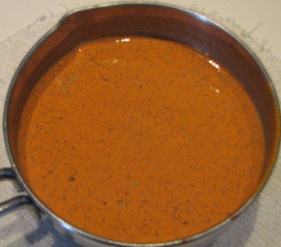 First, dissolve the curcumin in a bit of warm butter, not much at all, then slowly add the hot chocolate milk. Photo number 1 (above) demonstrates that curcumin dissolves perfectly in butter. No gritty remains. The second photo (here on the left) shows the end result, after the addition of hot chocolate milk. Both photos are a bit out of focus, I apologize. The second one doesn’t clearly show that the dissolved curcumin sort of floats on top, similar to what happens when you add a bit of oil to a glass of water. But I assure you that that is the case. By the way, in recent days I have been putting less chocolate into the mixture, which I find more palatable, oddly enough.
My concern about making chocolate lozenges would be curcumin degeneration. Heated up, then cooled in the fridge would that alter the healing properties of curcumin? No idea.
As for my reader’s suggestion to spread curcumin on French toast etc., my friend Don (see the link to his blog, Myeloma Hope, on the right-hand side of my homepage) tried adding curcumin to his morning oatmeal. Well, why not? I would dissolve the curcumin in a bit of butter first, then add it to the oatmeal. Since I love oatmeal, I may try that some day.
Just my 2 cents: whenever a substance is dissolved in another, there is a point called “saturation point”. Saturation is the point at which a solution of a substance can dissolve no more of that substance and additional amounts of that substance will appear as a precipitate. It seems to me that curcumin x oil mixture saturates. And the only way to make more curcumin dissolve is by adding oil. We tend to try to dissolve (and take) all the daily curcumin dose in one goulp. But I think that it should be wise to divide the dose in 2 or 3, and use a bit more oil to make each mixture, so not to reach the saturation point and let all the curcumin dissolve.
Peace,
Marcelo
Hello again Margaret,
I noticed in a recent Aggarwal paper that the efficacy of curcumin depended on a reduced level of GSH. Subsequently I came across this paper which seems to ascribe some of the apoptotic potency of sulforaphane to its depletion of GSH. I wondered if you had seen it and if sulforaphane might be a candidate for synergy with curcumin:
http://www.jbc.org/cgi/content/full/280/20/19911
I know I’m not posting in the right place, but I can’t figure how to start a new topic.
I’m just about to start taking cumin and would like to know how many teaspoons is the equivalent of 8 grams; I have no scales suitable to weigh this small amount.
Also, I can’t afford to go down the capsule road and will be using cumin from the place I buy all my curry spices. Do you have any suggestions on what I should add to it?
I was happy to learn that my over indulgence in red wine has a beneficial effect!!
Ciao
This is in response to Marianne’s question above.
You said that you were “about to start taking cumin”. Did you mean cumin or did you mean curcumin? Cumin is a common Indian spice, but it is not curcumin. They are two totally different substances. Curcumin is the powder that is an extract derived from turmeric, another Indian spice. Cumin is from an entirely different plant and has no medicinal properties like curcumin, to my knowledge. If you are trying to take what Margaret is talking about in her blog, then take curcumin, not cumin. Curcumin is a reddish orange/brown powder and cumin is a brown powder.
One level half teaspoon on non-compacted curcumin powder weighs about 1300 mg. To get 8 grams of curcumin powder you would need about one level tablespoon of it.
I think you would be better off to simply buy curcumin in capsules, although it is available online at somewhat less cost as a bulk powder.
If you get it on your countertop, hands or clothes you can’t wash it off with water. But alcohol liquid or gel dissolves it and removes it after a few tries.
Wally, thanks so much for answering Marianne’s comment. I should have posted a comment publicly the other day, but what I did was write to her privately, as I do with many blog readers.
Another word of caution: don’t confuse turmeric (the spice) with curcumin (the spice’s extract or active ingredient). Turmeric contains at the most 8% curcumin. So you would have to take a huge amount of turmeric to reap the healthful benefits of curcumin! Make no mistakes: take curcumin, not turmeric (“curcuma” in Italian), not cumin.
By the way, a slightly heaping teaspoonful of C3 Complex curcumin (Sabinsa Corp) is about 4 grams.
Take care, Margaret
Hi Margaret,
I was just wondering, do you buy capsules and then crush them or do you buy the powder? I’ve just ordered a lot of capsules but am concerned that powder is better absorbed because it doesn’t have to be broken down as much. If you buy the powder would you mind letting me know where you buy it from?
Thanks,
Claire
Could I warm up olive oil and try mixing that with tumeric? I am not sure how much to take daily. I need to call mt. rose herbs and ask them about their mg per tsp. It sounds like it is not effective unless it is mixed with oil. I have cod liver oil and could take it at the same time but it wouldn’t be warm or mixed together. I assume the oil must be warm to dissolve the tumeric. Where would you buy just the curcumin?
I mix my curcumin with yogurt(not low fat)and flax seed oil. I use the 500mg capsules, I take two and will try to get to up to 4 capsules.
Curcumin can only be digested with fat, so that is why yogurt, sometimes I will even use a teaspoon of sour cream and 1 tbls flaxseed or olive oil. I mix up and let set for 10 minutes and then restir, that seems to desolved it all.
I get mine at Walmart, use to buy online but so expensive as long as the tumeric has 95% curcumin in it, then it is good.
Hope this helps.
Deb
I have cancer in what is called the soft palate or mouth and nose. Since I watched both my Dad & Mom do the chemo and radition and surgery treatments I will not go that route. Hopefully they are cheering me on from beyond and the choice I am making. I am drinking “tea” with 2 tsp of tumeric in it for now. I have ordered capsules with that and black pepper in it to take because trying to drink that much tea everyday is hard. After reading these blogs I will add oil. I started slowly to get my body use to it. From the sound of things the oil will have other benefits as well like making my skin better because my RSD keeps it dry and burning. Sandy
Sandy,
Have you tried taking Curcumin? The tumeric is ok, but isn’t nearly as potent. In your case – more may be better to help you with the cancer. Have you read Bombshell? If you get a chance read from page 201. It talks about how well this spice works to combat cancer. The book is fabulous if you can, read it all. Best of luck to you. I know you will beat this using all the right stuff. It had to be a hard decision to not have chemo or radiation – but I think you made the right choice. God Bless you! and best of luck
I have switch to Super Bio-Curcumin capsules(with black pepper) and also added bromelsin tablets which is a pineapple enzme which also fights cancer cells. I really wanted to stay with turmeric for one reason and that was it was cheaper and easy for everyone to get, wanted to help prove it could work. But since I could not track down the company where it came from to make sure it was the good stuff, I switched. I am lucky and can afford to buy the others but know many can’t. I hope that makes sense. I also take a Tbls spoon of coconut oil with it. The coconut oil is super good for not only your inside but can be used on your skin. I know I have read olive oil and fish and coconut oil are all good. What do you think? Is one better than another? Thank you for your reply. Sandy
Hi Sandy,
It sounds like you have things on track. I’m happy for you. I realize the alternatives are expensive and not covered by insurance – that is what makes it hard, But know that you are doing much more for your defense system instead of ruining it with drugs. I agree with you on the coconut oil – I love that too, but haven’t tried to put it with my curcumin, until now! Thanks, and best of luck with everything. Val
I do have some other questions and they are: Does it matter how and when you take the curcumin? I take two 400 mg capsules day.Is that enough? I take one in the morning and one in the evening right now. Do I need to take a tsp of oil with each dose? Pure coconut oil has very little taste so I just take it. Also wanted to let you know that I read you need to take bromelsin on an empty stomach for it to work. Has anyone else read this? I read that different medicines dissolve at different rates in your stomach so don’t know how long to leave my stomach empty. It does tend to give me a stomach ache taking it that way. Should curcumin be taken on an empty stomach, too, to be the most effective and if I understand the oil is to help it work better, is this right?
Sorry for all the questions but just want to make sure I am making what I take, work the best and not wasting it.
I surely appreciate all your time and help. Sandy
Brilliant info on the effectiveness of organic butter to completely dissolve curcumin. Have also discovered here it is very difficult to dissolve 100% in other oils, even with large amounts. I will try the butter next. I think for best absorption requires 100% dissolved, then 100% emulsified in liposomes. I’m also curious if ghee would also work which should be better for you (no casein or lactose or water), though the natural emulsion with water in butter may make it easier to absorb. Add a little cocoa and stevioside and you’ve got yourself a delicious chocolate. I am curious if the curcumin precipitates out as it cools to a solid. If so, turning it into a gnosh while hot might help keep it fine enough so that won’t hurt absorption.
Darn, did not dissolve like I hoped it would, no better in fact. Maybe you changed curcumin brands for the butter experiment? I’ve found swanson vitamins powders to be more difficult to dissolve than others. At least the Now Foods brand of quercetin was much finer than the swansonvitamins and much easier to make a tea from. I don’t know if that’s the case for curcumin too, but it might be.
Hello All!
Looking for thoughts, experience and/or first hand knowledge about the liquid form of C3 Complex Curcumin? It just seems to be popping up more when researching. Would love to hear feedback!
Enjoy the day!
Nellie
I have researched the best way of taking curcumin and it’s complicated. As noted above curcumin is essentially insoluble in water especially at low and moderate Ph. It will go into fats but then the fats are insoluble in water too so the curcumin will stay partitioned into the fat and not absorbed. Fat is solubilized by bile which is alkaline and fat dissolved curcumin is also more soluble at alkaline Ph but here curcumin is destroyed quickly by hydrolysis so using fat as a carrier is a dead end IMO.
For this reason I think it’s better to imbibe mixtures of ethanol and water as the carrier solvent. Limiting solubility of curcumin in pure water is .006 grams per liter. For pure ethanol it is 10 grams per liter. For mixtures it is a sliding scale between these two limits. Wine at 13% ethanol should carry 1.3 grams of solvated curcumin per liter bottle of wine. A therapeutic dose of curcumin is about 0.2 grams for a 100 kg adult at a minimum so one glass of wine should deliver one therapeutic dose. You can drink the curcumin as a slurry in Orange juice and chase it with the wine letting it mix in your stomach for better wine taste and excess curcumin slurried in the juice won’t hurt anything it just won’t dissolve beyond the solubility limit.
With this method you can achieve high sustained therapeutic dosings by drinking a glass of wine periodically throughout the day.
Good luck and kind regards.
“It will go into fats but then the fats are insoluble in water too so the curcumin will stay partitioned into the fat and not absorbed. Fat is solubilized by bile which is alkaline and fat dissolved curcumin is also more soluble at alkaline Ph but here curcumin is destroyed quickly by hydrolysis so using fat as a carrier is a dead end IMO.”
I think this is misinformation. One’s body absorbs fats all the time, through processes which would not be expected to break down curcumin. There are complex issues, though. Fat-soluble nutrients tend to be absorbed when consumed with a high-fat meal. When one eats a high-fat meal, the gallbladder releases more bile, which tends to emulsify fats. Pancreatic juices hydrolyze fats (triglycerides) with lipase, an enzyme which shouldn’t affect curcumin. Bottom line: take curcumin any way you want, but do so with a higher-fat meal for better absorption.
I speculate that black pepper aids absorption perhaps not through any direct chemical effect, but by the stimulation of those internal sensory mechanisms meant to detect the presence of fats. I.e., possibly the black pepper stimulates release of bile and pancreatic juices. I’m unaware of any research on this point, though.
Steve
“When my curcumin, which I buy from Swanson’s Vitamins, was mixed in all six of the above fats and other two fluids I noticed that there were tiny little residual grains of hard stuff that did not dissolve, like sand. But they could be crushed up with the back of a spoon into finer particles, which still did not dissolve.”
It seems that Swanson cannot make a supplement product without adding silica (silicon dioxide) to it; apparently as a “flow agent” to make manufacturing easier. This is why I will never buy anything made by Swanson (or any other company that adds silica to their products). The type of silica used in supplements and pharmaceutical products is in the form of amorphous nanoparticles, and there is evidence that this material is not biologically inert, but pro-inflammatory.
great advise, thank you
I put a good level teaspoonful of organic turmeric powder (no silica nano additive) into a shot-and-a-half of Swedka vodka, room temp., stirred it and waited for 10 minutes.
…slow sipping, with cold water chasing each sip, convinced my tongue and I that the turmeric actives were finally talking directly to my body, which gave me to feel my finger joints begin to free up while playing piano. If that’s a placebo effect, it’s a damn good one!
….however, I’m not at all certain that turmeric therapy will alleviate my allergic response to marketing. –may all beings be well and happy